-

·
Why Monitoring Hazmat Incidents Protects Your Business
Article Summary When it comes to hazardous materials transportation, ignorance is not bliss—it’s a compliance risk. Many shippers assume they’ll be informed if their shipment is involved in an incident, but that’s rarely the case. Most incident reports are filed by the carrier, and shippers may never hear about them unless they actively look. …
-
·
Following the Breadcrumbs to Enhance Hazmat Safety
Article Summary Using the trail of breadcrumbs from Hansel and Gretel as a framing device, this article, from Bob Richard, Vice President at HazMat Safety Consulting, argues that hazmat compliance failures are rarely caused by a single mistake — they’re usually the end point of a chain of small clues, documentation gaps, inconsistencies, and procedural…
-

·
How to Secure a DOT Emergency Special Permit Quickly and Effectively
Article Summary When hazardous materials (hazmat) compliance issues arise, companies need regulatory exceptions fast. Specifically, they may need a Department of Transportation (DOT) special permit processed on an expedited basis. But what does that really mean, and how do you actually get one approved quickly? Ryan Paquet, a former Director of Approvals and Permits at…
-

·
The Evolution of Lithium Battery Safety: Insights from the SAE G27 Lithium Battery Packaging Performance Committee
Article Summary Lithium batteries have become an essential part of modern life, powering everything from smartphones to electric vehicles. However, their widespread use has also raised significant safety concerns, particularly in air transport. The risk of thermal runaway, where batteries overheat and potentially catch fire, has led to stringent regulations and the need for robust packaging…
-

·
What is a Lithium-Ion Recall, and What Do Companies Need to Consider When Facing One?
Article Summary In today’s technology-driven world, lithium-ion batteries power everything from scooters, smartphones, and power tools to e-bikes and electric vehicles. While these batteries are safe and effective power sources, misuse or a defect can bring the risk of potential failures, leading to recalls. A lithium-ion recall involves retrieving defective or potentially dangerous batteries from…
-

·
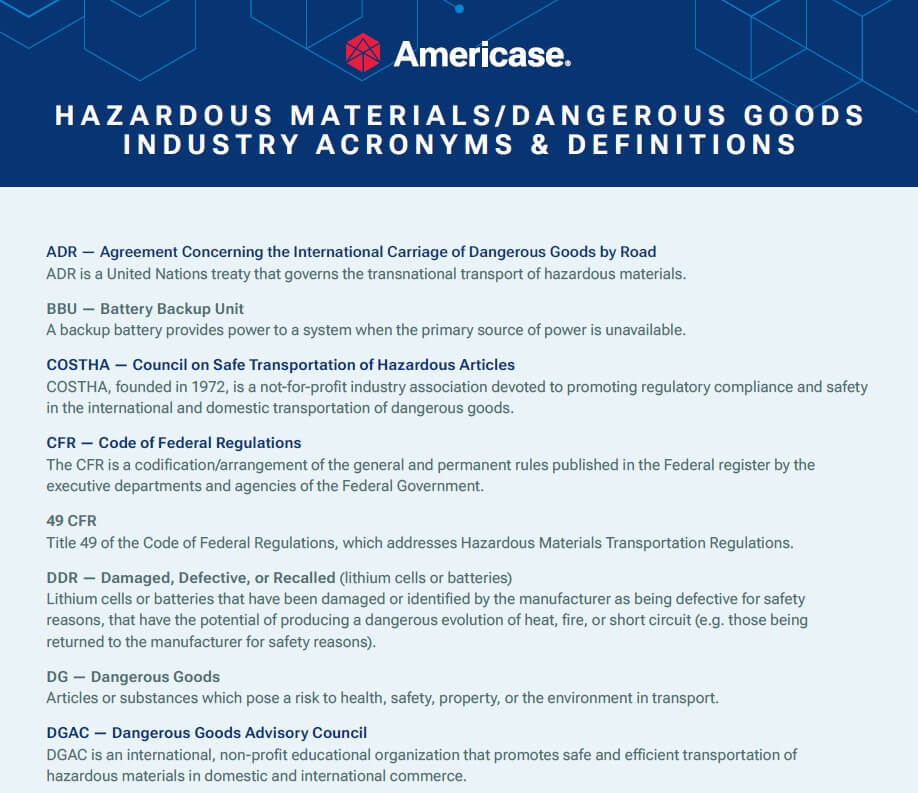
Hazardous Materials/Dangerous Goods Industry Acronyms & Definitions
Article Summary Hazardous materials and dangerous goods compliance runs on acronyms, and this downloadable reference guide collects 29 of the most common ones into a single glossary spanning the regulatory bodies, standards, and industry organizations that shape lithium battery and hazmat transport. It covers the UN framework (ADR, UN Model Regulations, the UN Informal Working…
-

·
Investigators Are People Too! and Other Things I Learned Working with PHMSA Field Ops
For 9 months of my career with USDOT / PHMSA, I was asked to oversee the Field Operations Team for the Office of Hazardous Materials Safety. It was a great experienced that provided me with insight and a more complete understanding of the hazardous materials safety system, of which so many of us are a…
-
·
Insights from Behind the Scenes
As we live through this unprecedented and challenging time in human history, I thought that I would share with you a quick story of how a small government agency (PHMSA) worked with industry and other government agencies to keep Americans safe. In 2014, the US was faced with an issue that it hadn’t dealt with…
-
·
Here We Go!
As I enter a new phase of my career, I want to share a few perspectives that I learned from my time working with PHMSA’s Approvals and Permits Division. Firstly, the people of the Approvals and Permits Division and across PHMSA are smart, hard-working, mission-driven people that are truly dedicated to safety. As a Federal…