Article Summary
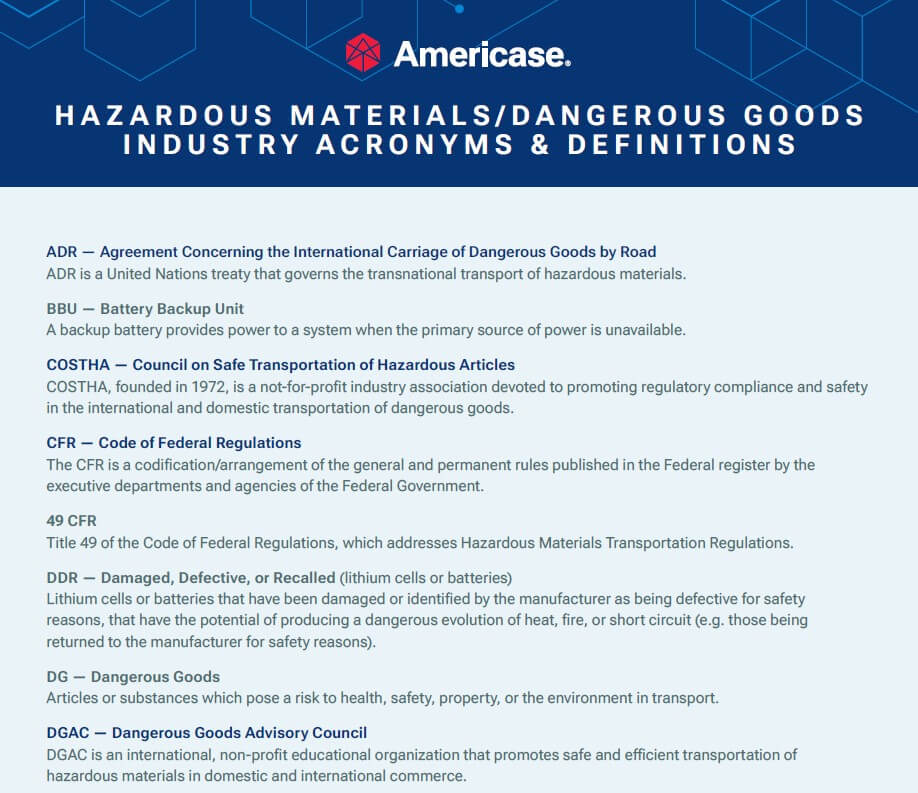
Hazardous materials and dangerous goods compliance runs on acronyms, and this downloadable reference guide collects 29 of the most common ones into a single glossary spanning the regulatory bodies, standards, and industry organizations that shape lithium battery and hazmat transport. It covers the UN framework (ADR, UN Model Regulations, the UN Informal Working Group), aviation-specific rules (FAA, IATA, the IATA Dangerous Goods Regulations, ICAO, and ICAO Technical Instructions), U.S. regulatory bodies (DOT, PHMSA, 49 CFR, and CFR generally), maritime transport (IMDG), Canadian requirements (TDG), and fire code standards (IFC), alongside industry associations directly relevant to lithium battery shippers such as COSTHA, DGAC, MDTC, PRBA, and SAE International, including SAE’s G-27 and J3303 committees. It also defines core technical terms shippers run into constantly, including DG, DDR (damaged, defective, or recalled lithium cells/batteries), HazMat, and BBU. The guide is meant as a quick-reference companion for anyone navigating the alphabet soup of hazmat and dangerous goods compliance across ground, air, and ocean transport.
FAQ
Q: What does the guide cover?
A: A glossary of 29 acronyms used across hazardous materials and dangerous goods compliance, spanning United Nations and international transport frameworks, U.S. regulatory bodies like DOT and PHMSA, aviation rules from FAA, IATA, and ICAO, maritime rules under IMDG, Canadian TDG requirements, fire code standards (IFC), and industry associations including COSTHA, PRBA, and SAE International.
Q: What’s the difference between DOT, PHMSA, and 49 CFR?
A: DOT (Department of Transportation) is the U.S. federal agency overseeing the national transportation system. PHMSA (Pipeline and Hazardous Materials Safety Administration) is the DOT agency specifically responsible for protecting people and the environment through the safe transport of hazardous materials and energy products. 49 CFR is the specific title of the Code of Federal Regulations that contains the hazardous materials regulations PHMSA enforces.
Q: What’s the difference between IATA and ICAO for air transport of dangerous goods?
A: ICAO is the United Nations agency that serves as the global forum for civil aviation and publishes the Technical Instructions (ICAO TI) for the safe air transport of dangerous goods. IATA is the trade association representing the world’s airlines, and its Dangerous Goods Regulations (IATA DGR) serve as the global reference manual airlines actually use to apply those requirements to shipments.
Q: What do DG, HazMat, and DDR mean in this context?
A: DG (dangerous goods) and HazMat (hazardous materials) refer to the same thing, articles or substances that pose a risk during transport, with the terminology varying mainly by region and regulatory framework. DDR specifically refers to damaged, defective, or recalled lithium cells and batteries, a category that carries its own handling and packaging requirements.
Q: What are SAE G-27 and SAE J3303?
A: Both are SAE International committees focused on lithium battery standards. SAE G-27 is developing a minimum performance standard for the safe shipping of lithium batteries by air as cargo, while SAE J3303 is a Recommended Practice defining test conditions for containing thermal runaway hazards during lithium battery storage.
Q: Who publishes the IMDG Code, and what does it cover?
A: The IMDG (International Maritime Dangerous Goods) Code is the framework governing the transport of packaged dangerous goods by sea, paralleling the role IATA DGR plays for air transport and 49 CFR/HMR plays for U.S. ground transport.