-

·
Navigating State-Specific Regulations for Lithium-Ion Batteries
Article Summary Lithium-ion battery regulation splits into two very different pictures depending on whether a battery is moving or sitting still. Transport is orderly: PHMSA governs it nationwide, batteries are uniformly classified as Class 9 hazardous materials in every state, and states enforce (but can’t rewrite) federal rules, with Texas alone issuing over 3,000 hazmat…
-

·
Are You Ready for IFC Section 320? Lithium Battery Storage Rules Are Coming Fast
Article Summary Lithium-ion battery storage regulation in the U.S. is fragmented today, but it’s converging fast around one benchmark: Section 320 of the 2024 International Fire Code (IFC), which sets requirements for storage setup, fire barriers or thermal-performance containers, suppression systems, ventilation, explosion-proofing, and detection. Adoption is happening jurisdiction by jurisdiction, on a rolling 12–24…
-

·
From Recall to Road-Ready: What It Takes to Respond Quickly to Lithium Battery Packaging Needs
Article Summary When a battery recall, prototype failure, or damaged-battery shipment hits, companies don’t have months to source compliant packaging, they typically need it within days. This article, featuring Chris Egloff, VP of Strategic Opportunities at Americase, explains how the company meets that timeline: Americase battery bags have been used in roughly 80% of Consumer…
-

·
What’s Next for Lithium-Ion Battery Transport Regulations?
Article Summary The release of the SAE G27 lithium battery packaging standard was a major milestone for safer battery transport, but this article makes clear it’s only the beginning of a longer regulatory evolution. It covers how the standard is being applied now: ICAO and the FAA are evaluating whether to formally integrate G27 testing…
-

·
Managing Lithium-Ion Battery Recalls: A Comprehensive Guide
Article Summary With the global lithium-ion battery market valued at over $60 billion in 2023 and projected to reach $180 billion by 2030, recall management has become a critical operational discipline rather than a rare contingency, and this white paper lays out why: at least 78 lithium-ion battery recalls occurred in the U.S. between 2012…
-

·
Why Lithium Battery State of Charge Matters: The 30% Rule and Beyond
Article Summary One of the best-known rules in lithium-ion battery transport is ICAO’s 30% state-of-charge rule, and this article explains both why it exists and why it isn’t enough on its own. Lithium-ion batteries are safest when they carry less stored energy: ICAO determined that at or below 30% charge, batteries have less stored energy…
-

·
The Evolution of Lithium Battery Safety: Insights from the SAE G27 Lithium Battery Packaging Performance Committee
Article Summary Lithium batteries power everything from smartphones to electric vehicles, but the risk of thermal runaway — where a battery overheats and potentially ignites — has made air transport packaging a critical safety concern. This article traces the origin and progress of the SAE G27 Lithium Battery Packaging Performance Committee, formed at the request…
-

·
Preparing for Regulatory Audits in the Lithium-Ion Battery Industry: Ensuring Compliance in Transportation and Storage
Article Summary An audit is only as good as the auditor conducting it, and this article argues that’s the weak point most lithium-ion battery compliance programs overlook: many companies rely on internal or external auditors who lack the depth of knowledge needed to conduct a meaningful audit, understanding both the letter and the spirit of…
-

·
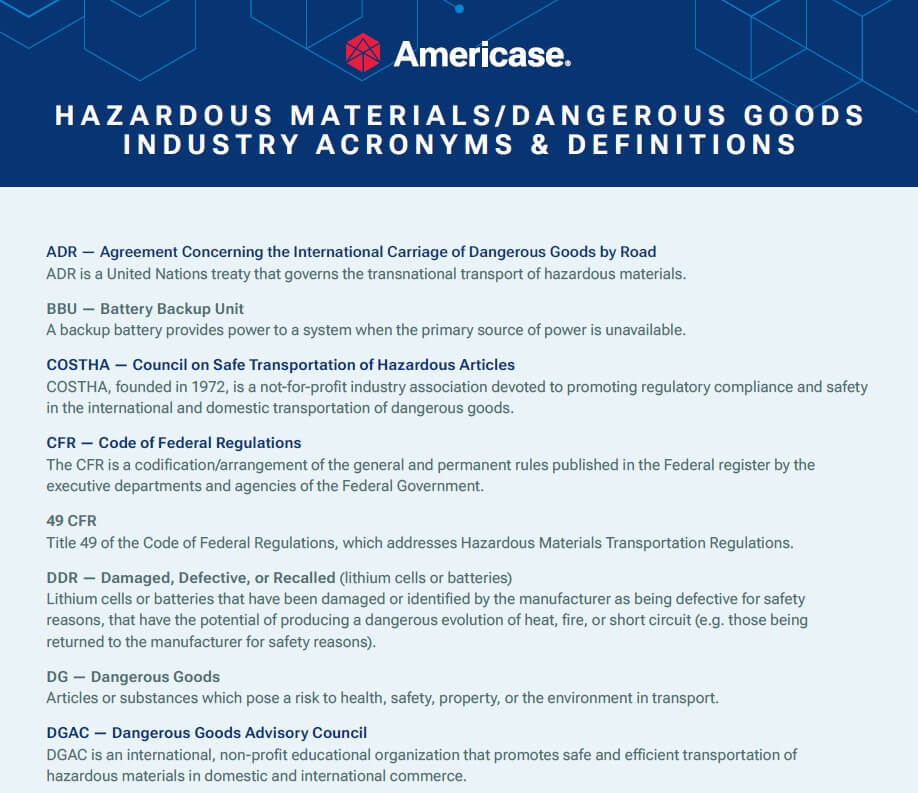
Hazardous Materials/Dangerous Goods Industry Acronyms & Definitions
Article Summary Hazardous materials and dangerous goods compliance runs on acronyms, and this downloadable reference guide collects 29 of the most common ones into a single glossary spanning the regulatory bodies, standards, and industry organizations that shape lithium battery and hazmat transport. It covers the UN framework (ADR, UN Model Regulations, the UN Informal Working…
-

·
A Look Inside 3 Committees Leading the Charge in Lithium Battery Storage and Transportation Regulations
Article Summary Lithium-ion batteries power everything from cellphones to EVs, and their strong safety record depends on painstaking, ongoing standards-setting work carried out by industry and international bodies. This article looks inside three committees currently shaping that work: SAE International’s G-27 Committee, which is developing a minimum performance standard for safely shipping lithium batteries by…