Key Facts
- Dense, liquid-cooled AI racks such as NVIDIA’s Blackwell and Vera Rubin platforms cannot be serviced on the data center floor; failed trays and rear-rack infrastructure are swapped out and shipped back to the OEM for factory refurbishment.
- Compute and switch trays connect to the rack’s cooling manifold through blind-mate liquid disconnects, so in-aisle repair creates coolant-leak and handling risk on hardware that can cost six figures per tray.
- Hot-aisle components, including vertical cooling manifolds, high-voltage DC busbars and NVLink copper backplanes, also have to be removed whole and returned to the manufacturer.
- The typical return-to-vendor workflow moves each part rack to cart, cart to staging, staging to crate and back again, and every handoff is a chance to warp a manifold, bend a pin or drop a tray.
- Wooden crates are not allowed on the data center floor because they shed particulate and add combustible load near high-voltage equipment.
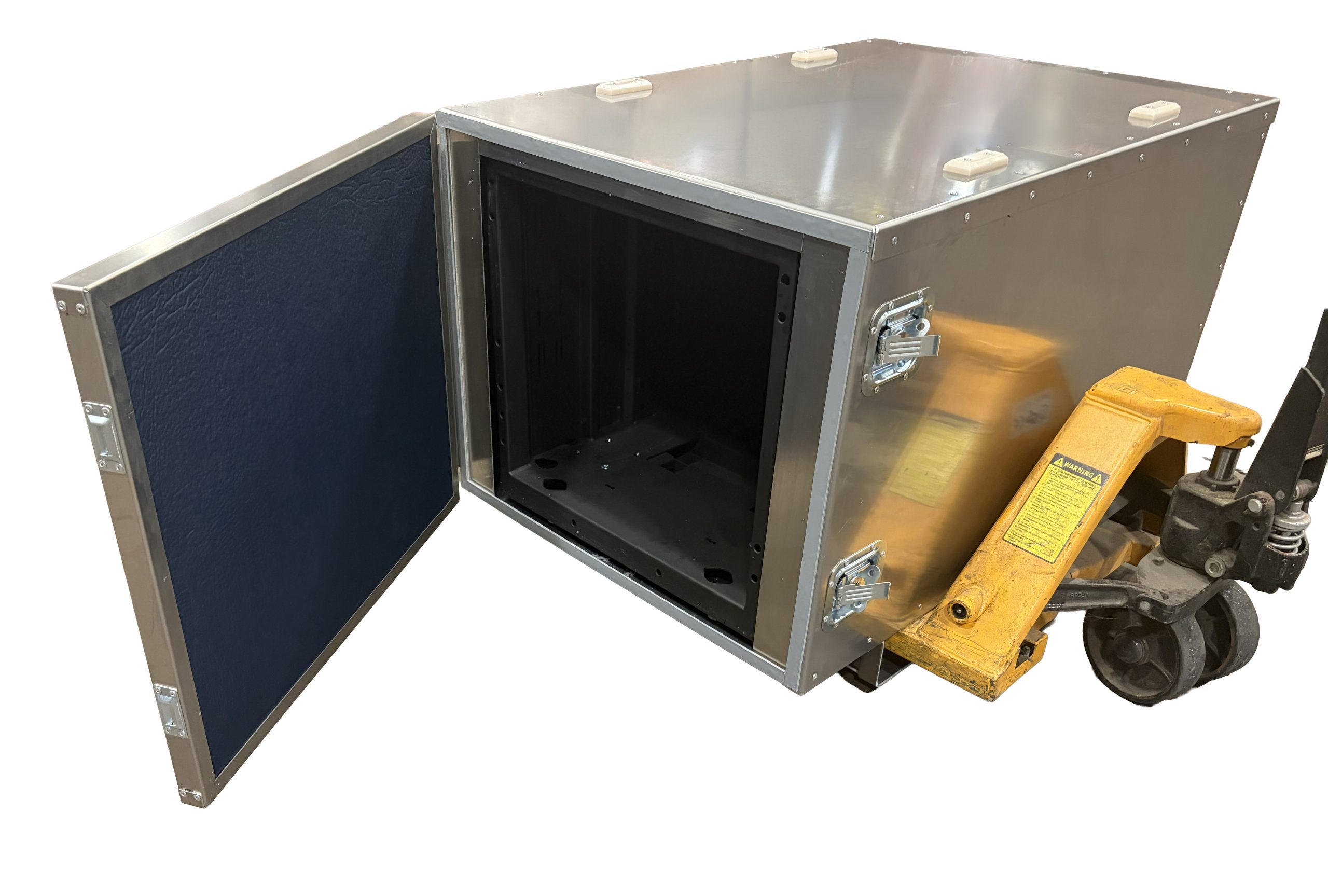
- Americase’s reusable Open Rack Version (ORV) containers carry the replacement part to the rack and become the return container for the failed one, which removes the secondary logistics team, the staging area and repackaging from the loop.
- Hyperscalers like Meta are standardizing racks and chassis so new accelerators drop into existing footprints, which makes fast, clean hardware rotation a core operating requirement.
Let’s face it: for decades, fixing a server looked pretty much the same. A data center tech walked down a cold aisle with a tool belt and a crash cart, cracked open a chassis, and swapped out a faulty stick of RAM or a dying CPU right there on the spot.
But the arrival of dense, liquid-cooled AI clusters completely broke that playbook. We’ve hit a massive turning point in daily operations. The old way of doing in-rack surgery is officially dead, replaced by high-stakes, rapid-fire logistics.
The Cold Aisle: Drop the Screwdriver, Grab a Shipping Case
To keep up with the brutal power demands of modern AI, architectures like NVIDIA’s Blackwell and upcoming Vera Rubin platform have to use direct-to-chip liquid cooling. Look at the front of these racks, the cold aisle. The compute and switch trays are unbelievably dense, incredibly heavy, and plumbed directly into the rack’s cooling manifold with floating blind-mate liquid disconnects.
Because these highly engineered trays easily cost six figures, they rely on precision-mated, hose-less designs. You absolutely cannot service them on the data center floor. The risk of a coolant leak or a tiny handling mistake is way too high.
Maintenance is now entirely modular. If a component goes dark, the tech decouples the entire liquid-cooled tray, swaps it with a fresh spare in a few minutes, and gets the rack back online. The broken unit? It gets boxed up right there and shipped back to the OEM for controlled, factory refurbishment.
The Hot Aisle Is Just as Complex
This “swap-and-ship” reality isn’t just a front-of-rack issue. The hot aisle at the back is packed with massive physical infrastructure that handles the heavy lifting: vertical liquid cooling manifolds, high-voltage DC power busbars, and colossal passive copper midplanes.
You can’t patch a vertical cooling manifold or a live power busbar on a 120kW rack while it’s running. Even the modern NVLink copper backplanes, which replace miles of messy cabling with massive, rigid copper boards, are covered in tens of thousands of microscopic connection pins. Bend just one pin, and the whole backplane is junk. When this rear-rack infrastructure fails or needs an upgrade, you have to carefully extract the entire vertical structure and send it back to the manufacturer.
The Inefficient, Multi-Touch Nightmare
Swapping parts instead of fixing them keeps your uptime high, but it drops a massive logistical headache right on your lap. Now you have to store piles of heavy, expensive spare parts, do the physical swap in a tight aisle, and orchestrate a flawless return loop to the OEM.
Right now, most operations handle this with a messy, multi-touch workflow:
- A tech pulls the heavy, broken tray or backplane out of the rack and balances it on a standard cart.
- They roll it down the hall and hand it off to the logistics team.
- Logistics moves it to a staging area, packs it into a shipping container, and sticks it on a truck.
- When the fixed asset comes back from the factory, the whole slow process happens in reverse.
Handling six-figure hardware that many times is an accident waiting to happen. Every single handoff, from rack to cart, cart to shelf, shelf to box, is another opportunity for someone to warp a manifold, bend a midplane pin, or drop an entire GPU tray. It simply doesn’t scale.
Cutting Out 90% of the Logistics Drama
What if your technician could handle the packing inherently, right in the aisle, without adding a single extra step to their workday?
In a smart workflow, the tech rolls the replacement part directly to the rack inside its own shipping and storage container that doubles as a return container. They pull the bad part out of the rack, place it in the container, pull the good part out of the same container, and slide it into the rack. It takes no more effort than loading a part onto a multi-shelf cart, but it completely cuts out the secondary logistics team, the staging area, and the repackaging risks.
The catch? You can’t just roll any box into the white space. Traditional wooden crates are heavy, awkward, and strictly banned on the data center floor. Wood sheds splinters, dust, and microscopic fibers that can wreck high-density hardware. Plus, bringing massive piles of combustible wood onto a floor packed with high-voltage electrical infrastructure is a massive fire hazard.
This is exactly where Americase changes the game. Our reusable Open Rack Version (ORV) containers are built specifically for this clean, rapid loop. They handle flat compute trays just as easily as the long, awkward dimensions of hot-aisle manifolds and busbars. They serve as the secure transport and storage container for the incoming good asset, and immediately turn into the rugged return box for the defective one. With floating base designs that soak up heavy road shock and vibration, they keep these high-value assets insulated from transit damage.
Meta’s “Boring” Strategy for Hyper-Scale Uptime
We’re already seeing this exact operational shift play out with the world’s biggest hyperscalers. Meta recently locked in a massive, multi-year partnership with NVIDIA to deploy millions of AI chips. But instead of designing completely bespoke, custom hardware layouts for every single chip generation, Meta is leaning hard into a modular ecosystem.
They are setting up their infrastructure to drop in NVIDIA’s next-gen hardware, including the upcoming Vera Rubin Ultra GPUs and liquid-cooled Kyber racks, straight into their existing footprint.
An excellent analysis by Six Rack Units called “The Boring Reason Meta’s AI Chip Strategy Might Beat Everyone Else’s” points out why this matters so much. Meta deliberately standardized their physical infrastructure so future AI accelerators can use the same chassis and racks.
As NVIDIA accelerates its roadmap from dense Blackwell architectures to the Vera Rubin platform, Meta’s “boring” setup lets them avoid tearing up their power and cooling infrastructure for every upgrade cycle. They simply slide out the old trays and boards, and drop the new ones in.
But a fast, modular upgrade cadence completely falls apart if your physical logistics are stuck in the past. When you’re constantly rotating heavy, incredibly valuable hardware in and out of a clean white space, reusable, clean transport containers aren’t a luxury. They are the linchpin of the entire operation.
Are You Ready to Actually Scale?
The hardware has evolved at lightning speed. Has your operation kept up?
Are you going to keep using the exact same slow, multi-touch return-to-vendor processes you’ve used for years, or are you going to reinvent your workflow for a liquid-cooled AI world?
Think about it: could a simple process tweak, backed by the right packaging solution, eliminate your product damage risks, slash your labor costs, and let your environment scale 2x, 3x, or 4x faster? The chips of tomorrow can’t move without the logistics of tomorrow. Explore our rack packaging solutions, talk to Americase, and stop letting your packaging bottleneck your growth.
NVIDIA Kyber and Rubin Ultra Showcase: Check out this close-up look at the real-world density of the NVIDIA Kyber racks and Rubin Ultra hardware to see why legacy handling and wooden crates just won’t cut it anymore.
FAQ Section
Compute and switch trays in racks like NVIDIA Blackwell and Vera Rubin plug into the cooling manifold through blind-mate liquid disconnects and can cost six figures each. Opening them in the aisle risks coolant leaks and handling damage, so the standard practice is to swap the whole tray and send the failed unit back to the OEM.
Swap-and-ship means a technician removes the failed tray, manifold, busbar or backplane as a complete unit, installs a spare, and ships the failed part back to the manufacturer for factory refurbishment. It keeps uptime high but turns maintenance into a logistics problem.
Wood sheds splinters, dust and fibers that can damage high-density hardware, and it adds combustible material to a space full of high-voltage electrical infrastructure.
The replacement part arrives at the rack inside an Americase Open Rack Version container. The tech places the failed part in that same container and installs the new one, so there is no separate logistics handoff, staging area or repacking step. Floating base designs absorb road shock and vibration in transit.
Meta is standardizing chassis and racks so new NVIDIA accelerators drop into its existing footprint. That makes hardware rotation faster and more frequent, which only works if parts can move in and out of the white space cleanly and safely.