
Article Summary
The 2024 International Fire Code introduces the first specific compliance framework for on-site commercial lithium battery storage, creating defined obligations for operators who cross the code’s threshold quantity and cannot claim one of its few exceptions. The central challenge for most facilities is not simply understanding what the requirements say — it is determining whether those requirements apply to their specific operation, which storage quantities and configurations trigger the compliance checklist, and where the highest operational barriers lie. This article addresses that framework directly, using the lens of fire code lithium battery storage regulations as they apply to commercial and industrial operations in 2026.
The article covers four interlocking topics. First, it explains the three main exceptions in the 2024 IFC — batteries installed in the equipment they operate, small batteries in original retail packaging, and batteries in temporary storage — that may remove an operation from the code’s scope entirely. Second, it examines the 15-cubic-foot threshold quantity that triggers the full compliance checklist, and walks through each requirement: occupational permit, comprehensive safety plan, fire detection, approved fire suppression, and two-hour fire barriers. Third, it focuses on the two-hour fire barrier requirement specifically, which is the most operationally disruptive provision and the one most likely to require facility modifications. Fourth, it details the two legitimate exits from that requirement — engineered containment packaging solutions, including those tested to prevent thermal event escape, and maintaining batteries at or below 30 percent state of charge.
For decision-makers managing battery storage at commercial facilities, the practical takeaway is twofold. Confirm which version of the fire code your jurisdiction currently enforces before making compliance investments, because many jurisdictions have not yet adopted the 2024 edition. And regardless of enforcement status, engage your local fire department proactively. A fire department with no prior knowledge of what’s stored in your building is not obligated to enter during an emergency — a risk that a documented permit, safety plan, and established site relationship directly addresses.
IFC 2024 and Lithium Batteries: New Storage, Safety, and Compliance Considerations You Can’t Ignore
The 2024 IFC introduces, for the first time, specific storage requirements for lithium batteries in commercial settings. For many companies, the immediate question isn’t whether the code exists — it’s whether it applies to them. The answer depends on what you’re storing, how much you’re storing, and how you’re storing it. Understanding where you fall in that framework is the first step toward building a solid and justifiable compliance framework for your facility.
The requirements can sound daunting when you first read through them. Occupational permits, two-hour fire barriers, suppression systems, and battery rooms are not small operational adjustments. But before jumping to the requirements, it’s worth understanding which operations are exempt from them entirely. The 2024 IFC includes meaningful exceptions that remove a significant share of commercial battery storage from its scope. Knowing where those lines are drawn saves organizations from overcomplicating their compliance approach or, on the flip side, from underestimating what actually applies to them.
This article walks through the 2024 IFC’s exceptions, the threshold quantities that trigger requirements, the specific compliance checklist once you’re over that threshold, and the two legitimate paths that let facilities avoid the most burdensome requirement of all: the separate battery room with two-hour fire barriers. It’s grounded in exactly what the code says and what it means for operators on the ground.
Does the 2024 IFC Apply to Every Lithium Battery You’re Storing?
Not necessarily, and that distinction matters significantly to how you approach your compliance strategy. The 2024 International Fire Code includes three notable exceptions that can remove a battery storage operation from the code’s requirements entirely. Understanding whether your operation qualifies for any of these exceptions is always the right starting point before working through the full compliance checklist.
The first exception covers batteries that are installed in the equipment they operate. If you’re storing electric vehicles, power tools, e-bikes, or any product where the battery is already contained inside the device, those products are not subject to the IFC storage requirements. The fire code distinguishes between storing a standalone battery and storing a product that happens to contain one. For manufacturers and distributors whose inventory consists of finished, battery-integrated goods, this exception is a meaningful relief from compliance obligations. The storage of those products simply isn’t covered by the code.
The second exception applies to consumer-scale or retail-packaged batteries. Laptop batteries, cell phone batteries, and similar small-format cells remain outside the requirements as long as they’re in their original retail packaging. Once batteries of that type are removed from retail packaging and staged in bulk, the exception no longer applies. For electronics distributors managing sealed consumer goods, this is worth knowing and documenting.
The third exception is for temporary storage, and it’s the least precisely defined of the three. The word “temporary” isn’t defined in the code itself, making it subject to interpretation by the local fire marshal. As a practical matter, the intent covers situations like a pallet or two of batteries sitting on a warehouse floor while being actively integrated into a product. If batteries are moving through a production process rather than being stored statically, that may qualify. What doesn’t qualify is using the word “temporary” as a general defense for keeping batteries on site indefinitely without a storage plan.
The International Code Council’s 2024 IFC makes clear that these exceptions are specific and limited. A company storing standalone electric vehicle battery packs that aren’t installed in vehicles, aren’t retail-packaged, and aren’t moving through active production can’t claim any of the three. For those organizations, the threshold quantity and requirements apply in full. Our regulatory compliance services help clients work through exactly which category their operations fall into before making any compliance investments.
What Requirements Are Triggered Once You Cross the 15-Cubic-Foot Threshold?
Once you’ve confirmed that none of the three exceptions apply to your battery storage operation, the next question is whether you’re over the threshold quantity. The 2024 IFC establishes 15 cubic feet of battery storage volume as the trigger point — roughly the equivalent of two standard 55-gallon drums. In many commercial settings, a single electric vehicle battery pack will exceed that volume on its own. Once you’re over 15 cubic feet within a fire area, the requirements apply and you’re walking through a defined compliance checklist.
The first requirement is an occupational permit. This isn’t an onerous process, but it is a significant shift from the pre-2024 world where no permit was required for lithium battery storage at all. The permit requires you to go to your local fire code official proactively, disclose what you’re storing, describe how you’re storing it, and get their approval on your storage configuration and overall safety plan. The value of this step goes well beyond the paperwork. Before 2024, some companies never had a fire department representative on site to review how batteries were being stored. That created situations where firefighters responding to an emergency had no idea what they were walking into — and under those conditions, a fire department is not obligated to enter a building with unknown hazardous materials present. The National Fire Protection Association consistently identifies pre-incident planning and site familiarity as among the most critical factors in effective emergency response, and an occupational permit directly supports both.
From there, the requirements build toward a comprehensive safety plan, which most established businesses already have in some form: emergency procedures, evacuation routes, meeting points, and fire exit documentation. You’ll also need a functioning fire detection or alarm system. Options include standard smoke alarms, radiant energy detectors, and air-aspirating smoke detection systems that can identify combustion products earlier in the development of a fire event.
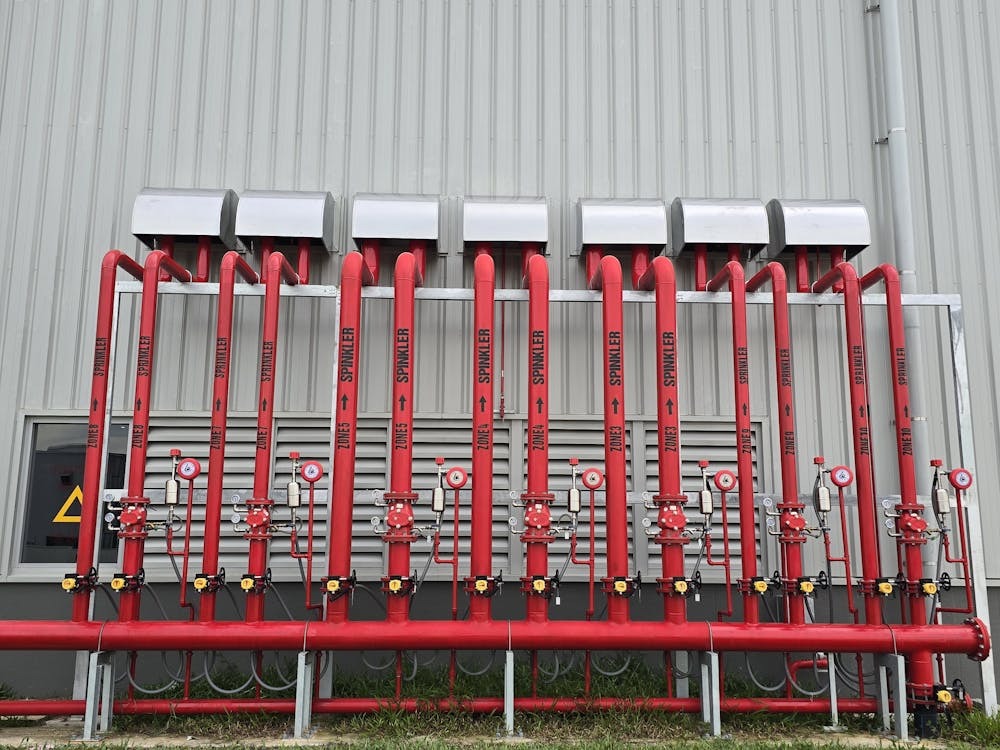
Fire suppression is also required. The most common solution is an automatic sprinkler system, though the key word in the code is “approved.” In fire code language, “approved” means your local fire marshal has signed off that the system in place is adequate for the specific hazards your batteries present. That determination depends on your quantities, storage configuration, and building layout — not a generic standard. Working through that approval process collaboratively with your fire code official is part of the compliance picture, and it’s one more reason the proactive relationship supported by the occupational permit matters so much operationally.
Why Is the Two-Hour Fire Barrier the Biggest Compliance Hurdle in the 2024 IFC?
Of all the requirements in the 2024 IFC for lithium battery storage, the two-hour fire barrier is the one that creates the most operational disruption — and the one that catches the most companies off guard. The requirement is straightforward in principle: lithium batteries above the threshold quantity must be stored in an area that is completely separated from the rest of the facility by a two-hour fire-rated barrier. In practice, that could mean designating a dedicated battery room, and for facilities that weren’t built with this requirement in mind, it can mean significant retrofitting.
The reason for the requirement isn’t arbitrary. Before 2024, it was common practice to store lithium batteries mixed in with general warehouse inventory — adjacent to paint storage, plastic pallets, cardboard, or other combustible materials. The 2024 IFC is specifically designed to end that practice. The National Fire Protection Association’s research foundation has documented that when lithium battery thermal events occur in mixed-inventory environments, the proximity of other combustible materials dramatically accelerates fire spread and complicates suppression efforts. A two-hour fire barrier is designed to give emergency responders time to respond, give building occupants time to evacuate, and prevent a single battery thermal event from becoming a facility-consuming fire.
Think about what a two-hour fire barrier actually accomplishes in a worst-case scenario. If a thermal runaway event begins inside a properly designated battery room, the fire should remain contained within that space for at least two hours. That window allows the fire department to arrive, understand what they’re dealing with, and respond in a way that protects both the building and personnel. Without those barriers, a thermal event in a battery stored next to conventional warehouse inventory can escalate into full building involvement before emergency responders have time to mount an effective response. The barrier is as much about life safety and response capability as it is about property protection.
For companies that currently store batteries in open warehouse space alongside other inventory, this requirement is the clearest call to action in the 2024 IFC. Understanding what your building currently has in terms of fire-rated construction is a sensible first step. Our smarter way to store lithium batteries resource provides additional context on how storage configurations are evolving in response to these updated requirements and what options are available before committing to construction.
How Can You Get Out of Building a Separate Battery Room?
The two-hour fire barrier requirement is the steepest compliance hurdle in the 2024 IFC, but the code itself provides two legitimate paths that allow facilities to meet its intent without constructing a dedicated battery room. Both are recognized explicitly by the code, and both are options our team works through with clients who are trying to avoid major building modifications.
The first path is engineered containment at the packaging level. The logic behind the battery room is that it creates a fire barrier between a thermal event and the rest of the building. The 2024 IFC allows that containment function to be performed at a smaller scale — at the level of the container or packaging the batteries are stored in rather than at the room level. If you store your batteries in a container that has been tested and demonstrated to prevent flame escape, fragment ejection, and elevated exterior temperatures during a thermal runaway event, you don’t need a separate battery room. Those batteries can be placed anywhere in the facility as long as they’re covered by smoke detection and fire suppression. This gives facilities significant operational flexibility and avoids the cost and disruption of construction. Think of it as shrinking the containment function down from a room to a box — the protection is equivalent, just scaled differently.
The second path is managing state of charge. The Pipeline and Hazardous Materials Safety Administration and international aviation regulators established the 30 percent state-of-charge threshold for lithium batteries on aircraft roughly a decade ago, based on the principle that a battery carrying less stored energy presents a substantially less severe thermal runaway event. The 2024 IFC applies that same principle to on-site storage: if you can demonstrate that your batteries are stored at or below 30 percent of their rated capacity, you don’t need a battery room. The reasoning is grounded in fire behavior. A battery at 30 percent state of charge that goes into thermal runaway will produce some heat and smoke, but it’s very unlikely to generate enough thermal energy to drive a neighboring battery into thermal runaway. Battery-to-battery propagation — the scenario that turns a single cell failure into a multi-battery catastrophic event that takes down entire buildings — requires far higher energy levels than 30 percent state of charge provides. Keeping batteries at or below that threshold essentially breaks the propagation chain.
Whether the right path is engineered containers, a state-of-charge management protocol, or a combination of both depends on your specific battery chemistry, storage quantities, and facility layout. Our general regulatory guidance services include walking through both options in the context of your actual operation so you can make an informed decision before spending money on construction or equipment.
From Requirements to Action: What to Do Before Your Jurisdiction Adopts the IFC 2024
The IFC 2024 represents the most specific and actionable guidance on commercial lithium battery storage that the fire code community has ever produced. For many organizations, it’s the first time they’ve had a clear framework to work within, and that clarity — even when the requirements are demanding — is a meaningful improvement over the ambiguity that existed before. The exceptions are clear, the threshold is defined, the compliance checklist is specific, and the exits from the most burdensome requirement are codified.
Two things are worth carrying out of this overview. First, the requirements only create a legal compliance obligation once your jurisdiction has formally adopted the IFC 2024. Before investing in battery rooms, permits, or storage upgrades, confirm what fire code standard your state, county, or city currently enforces. Many jurisdictions are still operating under the 2018 or 2021 edition, and in those places the 2024 provisions aren’t yet legally enforceable. That doesn’t mean the compliance work isn’t worth doing — it means you have the time to do it thoughtfully rather than reactively.Second, your relationship with your local fire department is as important as any code provision. The 2024 lithium battery requirements are new to the IFC and may be unfamiliar to the fire officials in your area. Fire departments are responsible for an enormous range of hazards covered by hundreds or thousands of pages of code — lithium battery storage provisions that just landed in the 2024 edition may not be on their radar yet. Working with them proactively, sharing what you have on site, how it’s stored, and what your emergency response plan covers, is the difference between a fire department that arrives knowing exactly what they’re dealing with and one that declines to enter your building because they don’t. That’s not a hypothetical risk — it’s a documented consequence of the pre-2024 environment where no permits and no site reviews were required. Contact our team to discuss what the 2024 IFC means for your specific storage operation.
By Mike Pagel