Free October 6 LinkedIn Live session covers why online sellers may carry significant hazmat shipping responsibilities and what platforms, 3PLs and small sellers can do to strengthen compliance
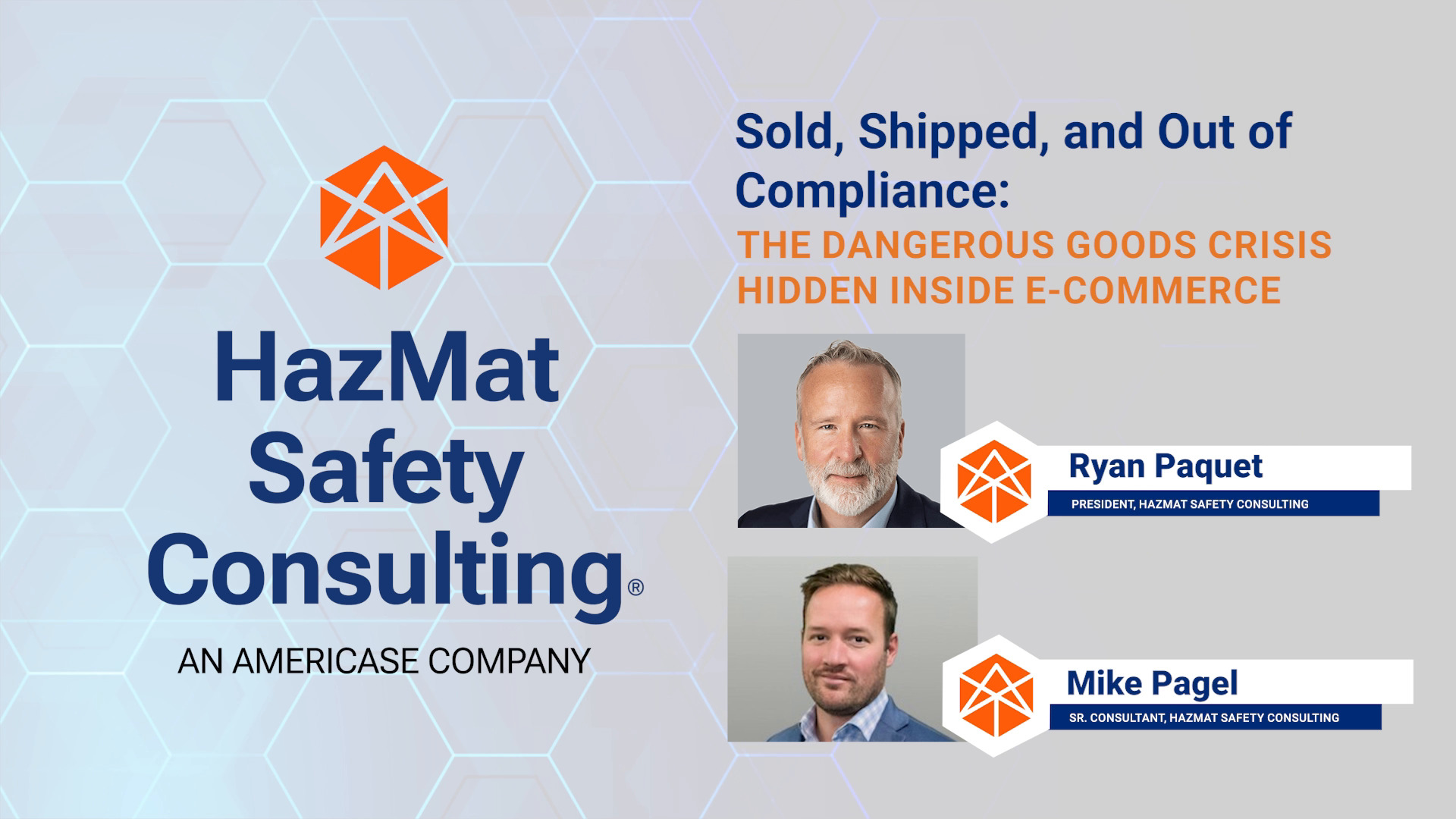
WAXAHACHIE, TX – October 1, 2026 – HazMat Safety Consulting (HSC), an Americase International company, will host a free LinkedIn Live webinar, “Sold, Shipped, and Out of Compliance: The Dangerous Goods Crisis Hidden Inside E-Commerce,” on Tuesday, October 6, 2026, at 11 a.m. CDT. The session will explain why individual online sellers, not the marketplaces where they sell, may be legally responsible for the hazardous materials they ship, often with little or no formal dangerous goods training.
Under the federal Hazardous Materials Regulations (49 CFR 171.8), an “offeror” is a person who performs, or is responsible for performing, certain pre-transportation functions for a hazardous material or tenders the material to a carrier for transportation. In e-commerce, that role may fall to an individual seller who prepares and ships an order rather than the marketplace that hosted the sale. Everyday products sold online, including lithium batteries and the devices that contain them, aerosols, perfumes and nail polish, can be regulated as hazardous materials in transportation.
Regulators are already testing where marketplace responsibility begins. In a July 30, 2024 decision, the U.S. Consumer Product Safety Commission ruled that a major online marketplace was legally responsible, as a “distributor,” for recalling hazardous products sold by third-party sellers and fulfilled through its warehouses, a decision the company is challenging in federal court. Hazmat shipping rules offer no comparable standard: the seller who prepares and ships a package may still bear the compliance burden.
The risks are visible in federal data. According to the U.S. Department of Transportation, approximately 1,500 transportation incidents occur each year when undeclared hazardous materials are shipped. Carriers are responding: as of July 12, 2026, the U.S. Postal Service charges a $50 fee on commercial packages found to contain hazardous materials that were not properly declared and labeled. Citing increasing lithium battery incidents, the Pipeline and Hazardous Materials Safety Administration (PHMSA) proposed on September 21, 2026, to add “thermal runaway” as an outcome on the federal hazardous materials incident report form.
“I helped administer the rule that defines who’s responsible for a hazmat shipment,” said Ryan Paquet, President of HazMat Safety Consulting. “It was built for a world of manufacturers and freight forwarders. Nobody wrote it with a garage seller and a marketplace checkout page in mind.”
The 60-minute session will trace how non-compliant shipments move from an untrained seller’s listing onto aircraft, sort facilities and delivery trucks, and what platforms, compliance teams and third-party logistics providers (3PLs) can be doing now to strengthen dangerous goods compliance as e-commerce continues to evolve.
Speakers
- Ryan Paquet, President, HazMat Safety Consulting — The former Director of the Approvals and Permits Division at PHMSA, Paquet brings firsthand experience with federal regulatory frameworks and enforcement priorities.
- Mike Pagel, Senior Consultant, HazMat Safety Consulting — Formerly with PHMSA’s Hazardous Materials Information Center, Pagel works directly with e-commerce and last-mile logistics clients on dangerous goods compliance, giving him a ground-level view of the challenges facing e-commerce and parcel networks.
Key Topics
Attendees will learn:
- Why the “person who offers” standard can place significant compliance responsibility on individual sellers
- How non-compliant shipments move from a seller’s garage to the aircraft, sort facility or delivery truck
- The enforcement challenges PHMSA and the Federal Aviation Administration (FAA) face as e-commerce expands the number of individual shippers
- What proactive dangerous goods compliance can look like for marketplaces, retailers and 3PLs
- What counts as “fully regulated hazmat,” and how small sellers can tell if they are personally responsible
Session Details
Session: Sold, Shipped, and Out of Compliance: The Dangerous Goods Crisis Hidden Inside E-Commerce
Presenters: Ryan Paquet and Mike Pagel
Date: Tuesday, October 6, 2026
Time: 11:00 a.m.–12:00 p.m. CDT (12:00–1:00 p.m. EDT)
Location: LinkedIn Live
Cost: Free; recording provided to all registrants
For additional information or to register for the session, visit Americase International’s webinar registration page.
Frequently Asked Questions
Q: Who should attend this webinar?
A: E-commerce platform managers, marketplace compliance teams, 3PL and fulfillment directors, retail operations executives and small business owners who ship regulated products.
Q: Is this only a problem for air shipments?
A: No. Air transport carries the strictest restrictions, but ground and parcel networks have their own classification, packaging and documentation requirements that untrained sellers often overlook.
Q: Is there a cost to attend?
A: No. The webinar is free, but registration is required.
Q: What is a hazmat “offeror”?
A: Under 49 CFR 171.8, an offeror is any person who performs, or is responsible for performing, pre-transportation functions for a hazardous material, such as classifying, packaging, marking, labeling or preparing shipping papers, or who tenders it to a carrier. The offeror is responsible for making sure the shipment complies with the Hazardous Materials Regulations.
Q: Who is responsible for hazmat compliance when a product is sold on an online marketplace?
A: It depends on who performs the pre-transportation functions. When an individual seller packs and ships an order, that seller may be the offeror, even if the sale took place on a large marketplace. When a marketplace or 3PL fulfills the order, it may share or take on those responsibilities.
Q: What are the penalties for shipping undeclared hazardous materials?
A: Civil penalties can be significant. Under 49 CFR 107.329, a person who knowingly violates federal hazardous materials transportation law faces a civil penalty of up to $102,348 per violation, or up to $238,809 if the violation results in death, serious illness, severe injury or substantial destruction of property.
Q: Will a recording be available?
A: Yes. A recording of the webinar will be provided to all registrants.
###
About HazMat Safety Consulting
HazMat Safety Consulting (HSC), an Americase International company, provides dangerous goods regulatory, compliance and safety consulting across the product and logistics lifecycle. Its consultants include former regulatory leaders and technical experts with experience at the U.S. Pipeline and Hazardous Materials Safety Administration (PHMSA) and in international dangerous goods rulemaking, helping organizations navigate U.S. Department of Transportation (DOT), International Civil Aviation Organization (ICAO), International Air Transport Association (IATA), International Maritime Dangerous Goods (IMDG) Code and other dangerous goods requirements.
HSC serves organizations across aerospace, defense, energy, healthcare, technology and industrial markets, providing regulatory strategy, compliance assessments, training, emergency response planning and ongoing regulatory guidance. Services span regulatory strategy and gap analysis; classification, packaging, marking, labeling and documentation; training and certification; emergency response planning; and safety management system development. To learn more, visit the HSC website at americaseinternational.com/about-hazmat-safety-consulting or Americase International at americaseinternational.com.
Press Contact:
Marina Malamis
303-917-9888