HazMat Safety Consulting joined the Open Compute Project to help build battery specifications that cover transport, installation and end-of-life as one lifecycle.
Published Nov. 2, 2026 | Last updated Nov. 2, 2026
Key Facts
- What: HazMat Safety Consulting, an Americase International company, joined the Open Compute Project (OCP) as a Bronze member on Nov. 2, 2026.
- Why: Lithium-ion battery transport rules are largely consistent worldwide, but installation and storage rules vary by country and jurisdiction, creating compliance gaps for data center operators.
- Where gaps occur: When an installed battery is relocated, returned under warranty or sent for recycling, it becomes subject to dangerous goods transport rules again. Damaged or defective batteries face stricter rules.
- Next: HazMat Safety Consulting will contribute dangerous goods regulatory expertise to OCP initiatives, including the OCP Rack & Power Project.
At a Glance
| Announcement | HazMat Safety Consulting joined the Open Compute Project (OCP) as a Bronze member |
| Date | Nov. 2, 2026, Waxahachie, Texas |
| Company | HazMat Safety Consulting, a dangerous goods regulatory, compliance and safety consultancy and subsidiary of Americase International |
| Focus at OCP | Lithium-ion battery compliance across transport, installation, storage and end-of-life in data centers |
| OCP initiative | OCP Rack & Power Project (rack-level battery backup systems) |
| Spokesperson | Mike Pagel, Vice President, HazMat Safety Consulting; contributing author, OCP white paper Requirements for Energy Storage Systems Used in Data Centers |
| Industry context | In Uptime Institute’s Global Data Center Survey 2026 (606 suppliers), 45% reported rising customer adoption of lithium-ion batteries in the server rack |
| Framework | Battery Safety Lifecycle™, Americase International’s five-stage framework for managing battery risk |
WAXAHACHIE, Texas — Nov. 2, 2026 — Data center operators deploying lithium-ion battery backup systems face compliance requirements that change by country and by lifecycle stage, according to dangerous goods experts at HazMat Safety Consulting, which today joined the Open Compute Project (OCP) as a Bronze member to help close compliance gaps. HazMat Safety Consulting, an Americase International company, will contribute regulatory expertise to OCP, a global community developing open standards for data center infrastructure, on the transport, storage and handling of data center batteries.
The stakes became clear in September 2025, when lithium-ion uninterruptible power supply (UPS) batteries caught fire at South Korea’s National Information Resources Service data center in Daejeon while workers were preparing to relocate them, disrupting 647 government systems, according to South Korean authorities. Relocation is one of the lifecycle handoffs where, HazMat Safety Consulting says, compliance requirements change.
“Nearly half of data center suppliers in Uptime Institute’s 2026 global survey report rising customer adoption of lithium-ion batteries in the server rack, and the rules governing how those batteries move and are stored are evolving just as quickly,” said Mike Pagel, Vice President at HazMat Safety Consulting and a contributing author of the OCP white paper Requirements for Energy Storage Systems Used in Data Centers. “Too often, operators don’t realize there’s a compliance gap until a shipment is delayed, a permit is held up or an insurer raises concerns.”
Consistent in Transit, Fragmented on Site
Lithium-ion battery transportation is governed by relatively consistent international standards, including the UN Model Regulations, U.S. Department of Transportation requirements and international air and maritime shipping rules. However, once batteries arrive at a data center, installation and storage requirements can vary significantly by country and jurisdiction.
For example, NFPA 855 governs stationary energy storage systems in the United States, and the National Fire Protection Association is developing NFPA 800, a new battery safety code. Neither applies automatically in countries such as Germany, Japan or Singapore. As new battery technologies and applications emerge, regulatory requirements continue to evolve, creating additional challenges for data center operators managing facilities across multiple markets.
OCP’s white paper, co-authored by Pagel along with contributors across the data center industry, states that “no battery or other ESS technology is inherently safe.” Even where technical requirements align with international IEC standards, the paper notes, “implementation, permitting, and enforcement vary by country.”
Where Battery Compliance Gaps Occur
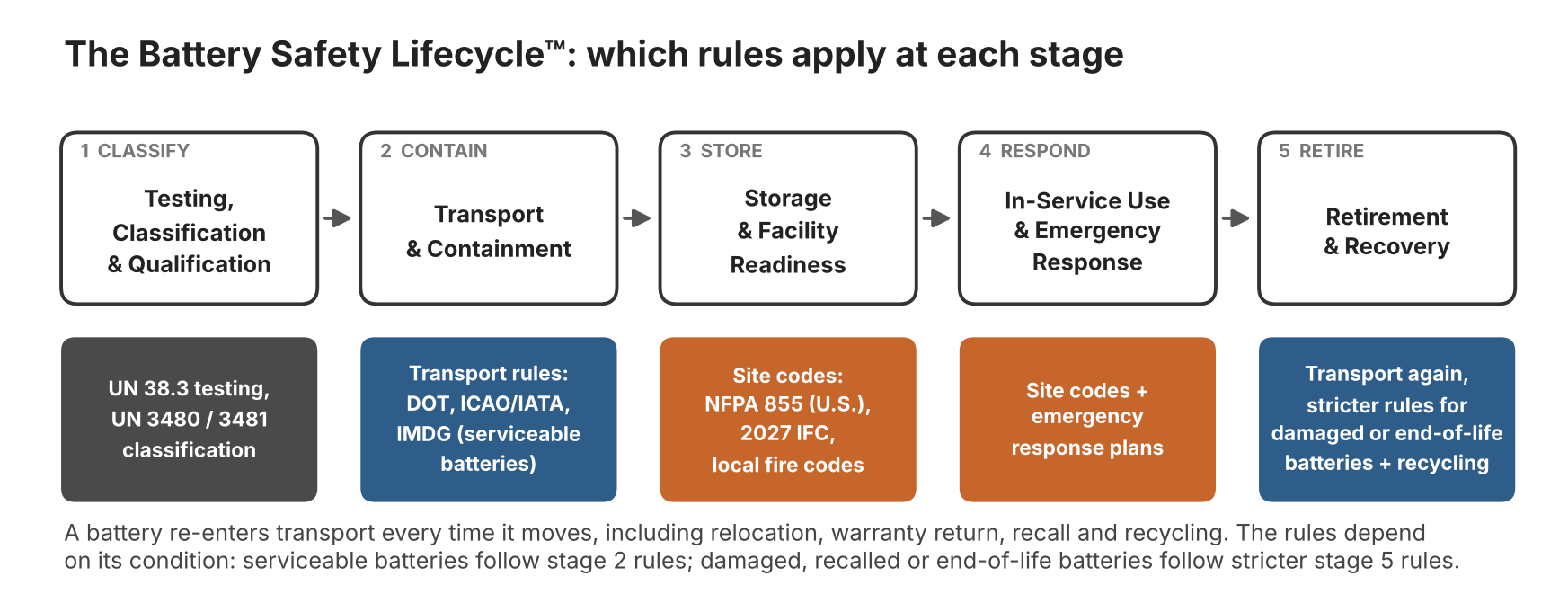
Americase International’s Battery Safety Lifecycle™ framework maps five stages for managing battery risk: testing, classification and qualification; transport and containment; storage and facility readiness; in-service use and emergency response; and retirement and recovery.
According to HazMat Safety Consulting, compliance challenges frequently arise when batteries move between different stages of their lifecycle. A battery installed in a data center becomes subject to dangerous goods transport rules again the moment it leaves the rack: when it is relocated, returned under warranty or sent for recycling. Damaged or defective batteries face stricter packaging requirements and are generally barred from air transport, which complicates warranty returns and replacements.
“Transportation has a mature, highly prescriptive framework, but once battery backup units (BBUs) arrive at the facility, requirements become more fragmented,” said Pagel. “Through OCP, we want transport, installation and end-of-life treated as one lifecycle, so operators aren’t discovering the rules when a carrier turns a shipment away.”
What HazMat Safety Consulting Brings to OCP
HazMat Safety Consulting brings decades of dangerous goods regulatory experience to OCP, including expertise from former U.S. and international regulators who helped shape today’s dangerous goods transportation standards. The company is part of Americase International, which also includes Fulcrum Testing and Americase. Together, the Americase International companies support each stage of the battery lifecycle: HazMat Safety Consulting advises on classification, transportation and storage requirements; Fulcrum Testing provides testing; and Americase designs packaging and containment systems for lithium-ion batteries.
Pagel also participated in an Oct. 15 panel at the OCP Global Summit focused on the battery compliance gap.
As an OCP Bronze Member, HazMat Safety Consulting will collaborate on initiatives including the OCP Rack & Power Project, which addresses infrastructure challenges associated with increasingly widespread rack-level battery backup systems.
Pagel is available for interviews on data center battery safety, dangerous goods transport rules and lifecycle compliance, and to contribute a bylined article on where data center battery compliance breaks down. To arrange an interview, contact Marina Malamis at mmalamis@hazmatsafety.com.
Which Rules Apply at Each Stage of the Battery Safety Lifecycle™?
The table below is a text version of the lifecycle graphic.
| Stage | Name | Rules that apply |
|---|---|---|
| 1. Classify | Testing, Classification & Qualification | UN 38.3 testing; UN 3480 or UN 3481 classification |
| 2. Contain | Transport & Containment | Transport rules (DOT, ICAO/IATA, IMDG) for serviceable batteries |
| 3. Store | Storage & Facility Readiness | Site codes: NFPA 855 (U.S.), 2027 IFC, local fire codes |
| 4. Respond | In-Service Use & Emergency Response | Site codes and emergency response plans |
| 5. Retire | Retirement & Recovery | Transport again, with stricter rules for damaged or end-of-life batteries, plus recycling rules |
A battery re-enters transport every time it moves, including relocation, warranty return, recall and recycling. Serviceable batteries follow stage 2 rules; damaged, recalled or end-of-life batteries follow stricter stage 5 rules.
Frequently Asked Questions
What did HazMat Safety Consulting announce?
HazMat Safety Consulting, an Americase International company, joined the Open Compute Project (OCP) as a Bronze member on Nov. 2, 2026. It will contribute dangerous goods regulatory expertise on the transport, storage and handling of lithium-ion batteries used in data centers.
What is the Open Compute Project (OCP)?
The Open Compute Project is a global community developing open standards for data center infrastructure.
Why do data center battery rules differ by country?
Lithium-ion battery transport is governed by relatively consistent international standards, including the UN Model Regulations, U.S. Department of Transportation requirements and international air and maritime shipping rules. Installation and storage fall under national and local codes, which vary by jurisdiction. For example, NFPA 855 governs stationary energy storage systems in the United States but does not apply automatically in countries such as Germany, Japan or Singapore.
Where do data center battery compliance gaps occur?
According to HazMat Safety Consulting, compliance gaps most often occur when batteries move between lifecycle stages. A battery installed in a data center becomes subject to dangerous goods transport rules again when it is relocated, returned under warranty or sent for recycling.
What rules apply to damaged or defective lithium-ion batteries?
Damaged or defective lithium-ion batteries face stricter packaging requirements and are generally barred from air transport, which complicates warranty returns and replacements.
How are lithium-ion batteries classified for transport?
Lithium-ion batteries are tested under UN 38.3 and classified as UN 3480 when shipped alone or UN 3481 when packed with or contained in equipment.
What is the Battery Safety Lifecycle™?
The Battery Safety Lifecycle™ is Americase International’s five-stage framework for managing battery risk: testing, classification and qualification; transport and containment; storage and facility readiness; in-service use and emergency response; and retirement and recovery.
What is a battery backup unit (BBU)?
A battery backup unit is a lithium-ion battery system installed at the rack level that keeps data center servers running during a power interruption. The OCP Rack & Power Project addresses infrastructure challenges associated with increasingly widespread rack-level battery backup systems.
What is the OCP energy storage white paper?
Requirements for Energy Storage Systems Used in Data Centers is an OCP white paper published in January 2026. It states that “no battery or other ESS technology is inherently safe.” Mike Pagel of HazMat Safety Consulting is a contributing author.
What happened in the 2025 Daejeon data center fire?
In September 2025, lithium-ion uninterruptible power supply (UPS) batteries caught fire at South Korea’s National Information Resources Service data center in Daejeon while workers were preparing to relocate them, disrupting 647 government systems, according to South Korean authorities.
Who is Mike Pagel?
Mike Pagel is Vice President at HazMat Safety Consulting and a contributing author of the OCP white paper Requirements for Energy Storage Systems Used in Data Centers. He spoke on an Oct. 15, 2026, OCP Global Summit panel on the data center battery compliance gap.
Related Resources
- The Battery Safety Lifecycle™ framework
- OCP white paper: Requirements for Energy Storage Systems Used in Data Centers
- OCP Global Summit 2026 panel: the battery compliance gap
- OCP Rack & Power Project
- Uptime Institute Global Data Center Survey 2026: supplier view
About HazMat Safety Consulting
HazMat Safety Consulting, a subsidiary of Americase International, provides dangerous goods regulatory, compliance and safety consulting across the product and logistics lifecycle. Its consultants include former regulatory leaders and technical experts with experience at the U.S. Pipeline and Hazardous Materials Safety Administration (PHMSA) and in international dangerous goods rulemaking, helping organizations navigate DOT, ICAO, IATA, IMDG and other dangerous goods requirements.
HazMat Safety Consulting serves organizations across aerospace, defense, energy, healthcare, technology and industrial markets. Services span regulatory strategy and gap analysis; compliance assessments; classification, packaging, marking, labeling and documentation; training and certification; emergency response planning; safety management system development; and ongoing regulatory guidance. Learn more at hazmatsafety.com.
About Americase International
Americase International, parent company of Americase, HazMat Safety Consulting and Fulcrum Testing, integrates containment engineering, dangerous goods regulatory strategy, and safety and performance validation to protect what is hazardous, what is valuable and what has never been shipped before. Americase has designed and manufactured protective cases since 1985; HazMat Safety Consulting is led by former U.S. and international regulators who helped shape today’s dangerous goods standards; and Fulcrum Testing provides lithium battery and product testing. Its conviction: containment, not just compliance. Based in Waxahachie, Texas, the company serves customers in electronics, aerospace, defense, data center, EV/automotive, energy storage, medical device and other industries. Learn more at AmericaseInternational.com.
Media Contact
Becca Cooper, PR Lead
press@americaseinternational.com
303-917-9888