Article Summary
The Globally Harmonized System (GHS) was created to standardize chemical classification and labeling worldwide, but this article explains why OSHA and DOT classifications still diverge in meaningful, practical ways despite that international standard. The core issue is that the two agencies regulate for different purposes: OSHA’s Hazard Communication Standard addresses workplace safety and covers both chronic and acute hazards based on long-term worker exposure risk, while DOT’s transport regulations focus specifically on immediate hazards during shipment. The article illustrates the gap with two concrete examples — OSHA classifies substances that cause eye irritation as hazardous even without other risks, while DOT does not regulate materials for transport based on eye irritation alone; and OSHA regulates carcinogens, mutagens, and teratogens because of their long-term health threat to workers, while DOT only regulates those same substances if they pose an immediate hazard during shipment. It also revisits a real point of industry confusion from 2015, when OSHA’s Hazard Communication Standard (HCS 2012) took effect and packages began displaying GHS corrosive pictograms without a corresponding DOT corrosive label — leading carriers to reject shipments until shippers clarified that “corrosive for workplace safety does not equal corrosive for transportation.” A reference table in the article defines the key acronyms (GHS, HCS, OSHA, DOT) and their respective purposes. The takeaway is direct: workplace hazard classification does not automatically determine transportation classification, so companies need to evaluate their chemicals under both regulatory frameworks separately to avoid compliance errors and shipment rejections.
The Globally Harmonized System of Classification and Labelling of Chemicals (GHS) was designed to bring consistency to how chemicals are classified and labeled worldwide.
So why, even with GHS, do OSHA and DOT classifications still differ?
Different Purposes, Different Rules
- OSHA focuses on workplace safety—both chronic and acute hazards.
- DOT focuses on transportation safety—immediate hazards that could occur during shipment.
This means a chemical might be classified as hazardous in the workplace but not in transportation, or vice versa.
Key Differences in Scope
Example 1:
- OSHA considers a chemical hazardous if it causes eye irritation, even without other hazards.
- DOT does not regulate materials solely for eye irritation.
Example 2:
- Carcinogens, mutagens, and teratogens are covered by OSHA because they pose long-term health risks to workers.
- DOT only regulates them if they present an immediate hazard during transport.
The 2015 Confusion
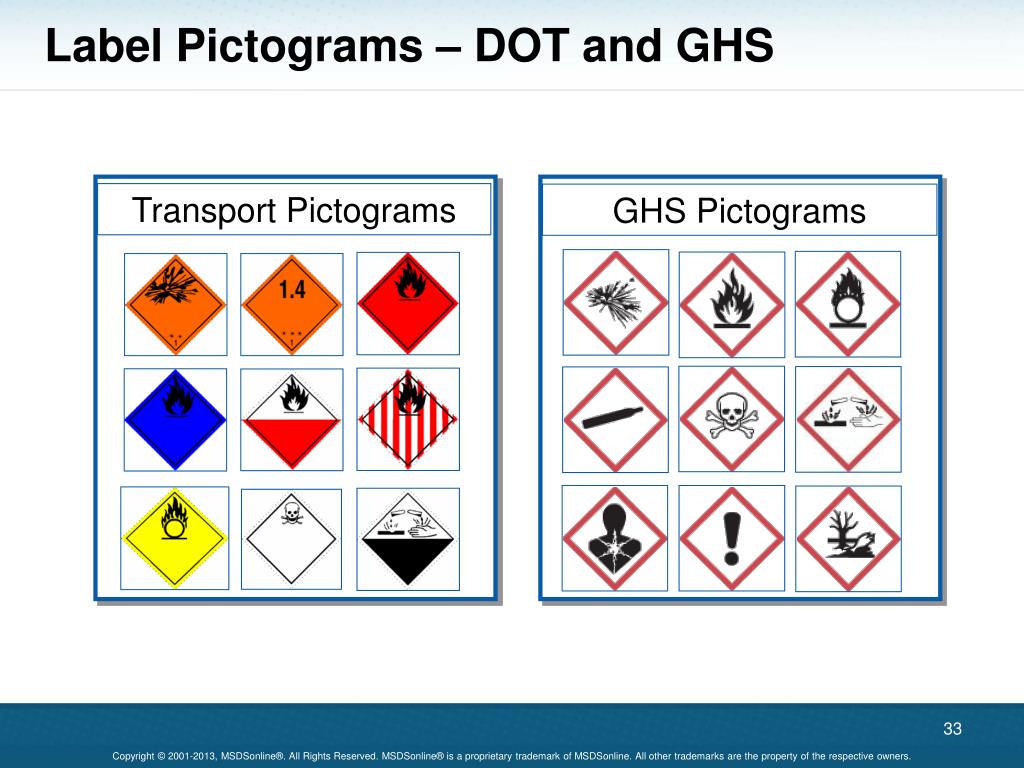
When OSHA’s Hazard Communication Standard (HCS 2012) took effect, some packages displayed the GHS corrosive pictogram without the DOT corrosive label.
- Carriers familiar with DOT rules rejected these shipments.
- Shippers had to explain the difference: corrosive for workplace safety ≠ corrosive for transportation.
|
Acronym |
Full Name |
Purpose |
|---|---|---|
|
Globally Harmonized System |
International standard for hazard classification and labeling. |
|
|
Hazard Communication Standard |
OSHA regulation requiring hazard communication in workplaces. |
|
|
Occupational Safety and Health Administration |
Oversees workplace safety. |
|
| DOT |
U.S. Department of Transportation |
Oversees hazardous material safety during transport. |
Even though GHS was designed to harmonize chemical hazard communication, differences remain between OSHA’s workplace-focused rules and DOT’s transportation-focused regulations. Knowing where these rules align—and where they don’t—can help you prevent confusion, shipment delays, and compliance issues. When in doubt, consult experts who understand both systems inside and out.
Do you have questions about your company’s compliance? Schedule a quick call with our expert today.
FAQ
Q: Why do OSHA and DOT classify the same chemical differently? A: OSHA’s Hazard Communication Standard addresses workplace safety and covers both chronic and acute hazards based on long-term worker exposure risk, while DOT’s transport regulations focus on immediate hazards during shipment. Because the two agencies regulate for different purposes, their classifications for the same substance don’t always align.
Q: How does eye irritation illustrate the difference between OSHA and DOT classification? A: OSHA classifies substances that cause eye irritation as hazardous for workplace purposes even without additional risks, but DOT does not regulate materials for transport based on eye irritation alone.
Q: How does DOT treat carcinogens and mutagens differently than OSHA? A: OSHA regulates carcinogens, mutagens, and teratogens because of the long-term health threat they pose to workers. DOT only regulates these same substances if they present an immediate hazard during shipment.
Q: What happened with GHS corrosive pictograms in 2015? A: When OSHA’s Hazard Communication Standard (HCS 2012) took effect, packages began displaying GHS corrosive pictograms without a corresponding DOT corrosive label. This created significant confusion, with carriers rejecting shipments until shippers clarified that “corrosive for workplace safety does not equal corrosive for transportation.”
Q: Does a workplace hazard classification determine a chemical’s transportation classification? A: No. The article is explicit that workplace hazard classification does not automatically determine transportation classification — companies need to evaluate their chemicals under both regulatory frameworks separately to stay compliant.
Q: How can companies avoid shipment delays caused by GHS/DOT classification mismatches? A: By understanding that OSHA (workplace) and DOT (transport) classifications serve different regulatory purposes and evaluating chemicals under both frameworks independently, companies can avoid the confusion, shipment rejections, and compliance errors that come from assuming one classification covers the other.