Mike Pagel will present on regulatory compliance and DDR shipping strategy, while COO John Redman joins an expert panel on safety in rapidly scaling battery markets.
Article Summary
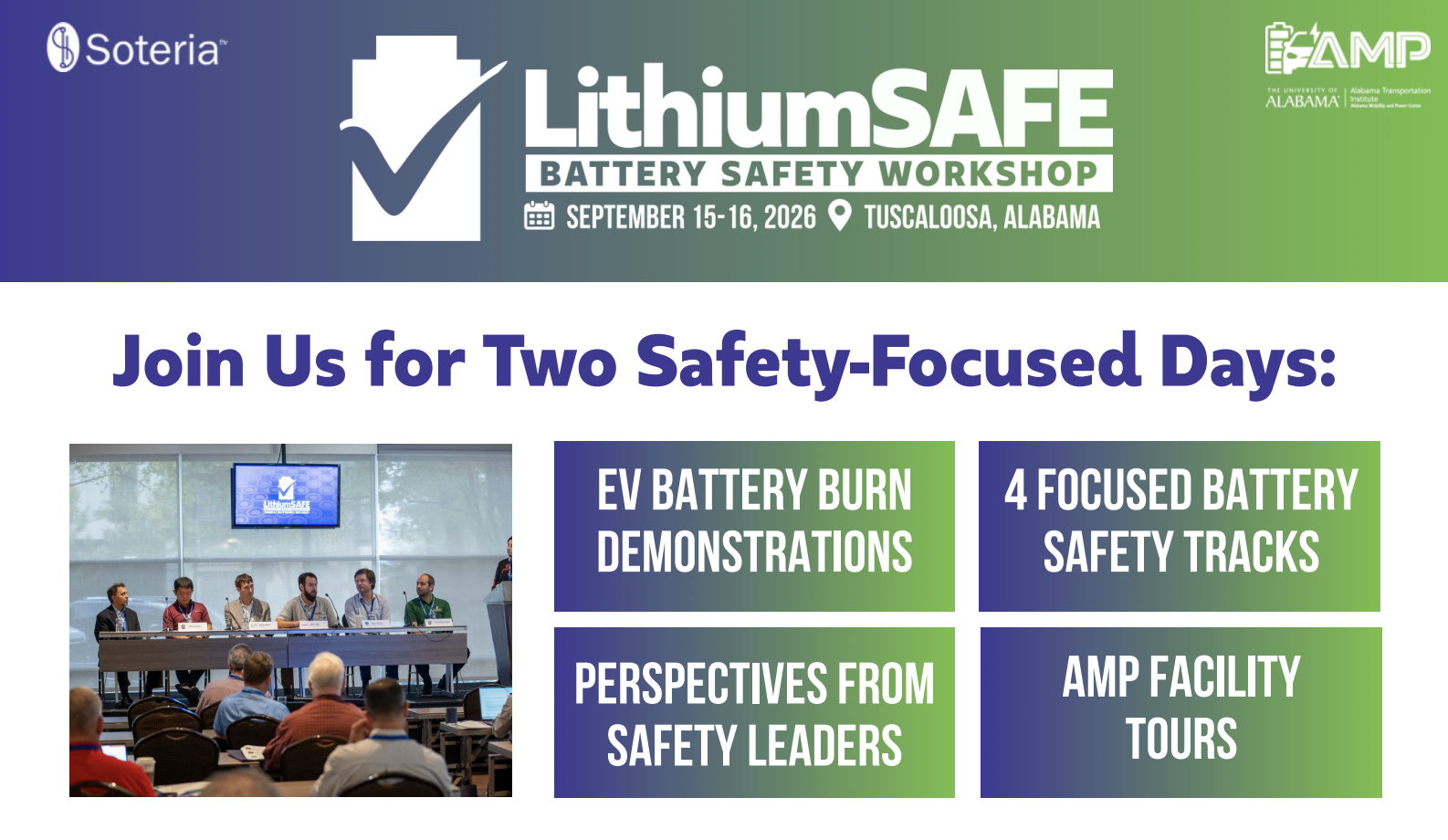
Americase International announced that experts from the company and its dangerous goods consulting division, HazMat Safety Consulting (HSC), will present and participate in an expert panel at LithiumSAFE Workshop 2026, held September 15–16 in Tuscaloosa, AL, and co-hosted by the Soteria Battery Innovation Group and the Alabama Mobility & Power Center. Mike Pagel, Senior Consultant at HSC, delivers a Track 3 featured presentation, “Regulatory Integration as a Competitive Advantage,” providing practical guidance on integrating UN 38.3, DOT and IATA requirements and damaged, defective or recalled (DDR) battery handling into product development, supply chain design and commercialization. Americase International COO John Redman joins a Track 4 expert panel, “How Safety Evolves in Rapidly Scaling Markets,” alongside representatives from LG Energy Solution Vertech, CSA Group and the Energy Security Agency to examine how battery safety practices must keep pace with rapid growth in electric vehicle, energy storage and data center markets. The announcement points to rising incident data as context for the urgency: FAA data shows 93 lithium battery-related events involving smoke, fire or extreme heat aboard aircraft in 2025, up from 89 in 2024, a roughly 4.5% increase. Both speakers frame dangerous goods compliance not as a late-stage cost but as a design-stage decision that can become a competitive and time-to-market advantage when built in early.
Who This Article Is For
Battery manufacturers, OEMs, cell and pack designers, supply chain and logistics teams, hazmat and dangerous goods compliance professionals, EHS and regulatory affairs staff, and fire and safety officials working across electric vehicle, energy storage and data center markets where lithium battery adoption is scaling quickly.
WAXAHACHIE, TX — September 14, 2026 —Americase International, a provider of mission-critical protection, testing, and dangerous goods compliance solutions, today announced that experts from the company and its dangerous goods consulting division, HazMat Safety Consulting (HSC), will present and participate in an expert panel at LithiumSAFE Workshop 2026, held September 15–16 in Tuscaloosa, AL.
Co-hosted by the Soteria Battery Innovation Group and the Alabama Mobility & Power Center, LithiumSAFE brings together battery manufacturers, designers, safety authorities, testing laboratories and logistics experts to address safety across the battery value chain.
As lithium-ion battery adoption accelerates across transportation, energy storage and data center markets, regulatory compliance and safe transport are becoming increasingly complex. Federal Aviation Administration data show 93 lithium battery-related events involving smoke, fire or extreme heat aboard aircraft in 2025, compared with 89 in 2024 (a roughly 4.5% increase). As battery technologies and applications continue to evolve, requirements governing classification, packaging, documentation and the handling of damaged, defective or recalled (DDR) batteries remain a critical consideration across the battery lifecycle.
“Most teams treat dangerous goods requirements as the last box to check before a product ships,” said Mike Pagel, Senior Consultant at HazMat Safety Consulting, and Americase International company. “By that point the packaging is designed and the supply chain is set, so every fix is an expensive one. Build the requirements in at the design stage and compliance stops being a cost line; it becomes a reason you reach the market first.”
Featured Presentation
Regulatory Integration as a Competitive Advantage: Navigating UN/DOT/IATA Compliance and DDR Shipping Optimization Across the Battery Value Chain
Track 3, September 16, 12:30–1:00 p.m.
Pagel will provide practical guidance on integrating UN 38.3, DOT, IATA and DDR battery requirements into product development, supply chain design and commercialization. Attendees will take away frameworks covering:
- Lithium battery classification and hazard determination
- Compliant packaging selection for shipping and storage
- Documentation requirements and special permit utilization
- Cost optimization strategies for dangerous goods shipping programs
- Containment and packaging considerations across manufacturing, transportation, end-of-life, and DDR handling
Expert Panel
How Safety Evolves in Rapidly Scaling Markets
Track 4, September 16, 2:20–3:00 p.m.
John Redman, Chief Operating Officer of Americase International, joins Kevin Fok, Director of Compliance of LG Energy Solution Vertech; Jody Leber, Global Business Manager of CSA Group; and Dalan Zartman of the Energy Security Agency to examine how battery safety practices must evolve alongside rapid growth in electric vehicles, energy storage systems and data center applications.
“Battery markets are scaling faster than the safety practices built around them,” said Redman. “The organizations that handle it well are the ones treating transport, storage and end-of-life handling as part of the product, not as someone else’s problem further down the chain.”
Speakers
- Mike Pagel, Senior Consultant, HazMat Safety Consulting — one of North America’s foremost experts on the transportation and storage of hazardous materials, with deep specialization in lithium battery regulations across IATA, IMDG, 49 CFR, ADR, and TDGR frameworks. His expertise spans not only what the regulations say today, but where they are heading as codes like NFPA 800 and NFPA 855 (2026) come into force.
- John Redman, Chief Operating Officer, Americase International — more than 30 years of executive leadership in advanced manufacturing and hazardous materials compliance, including Director of Global Compliance and Dangerous Goods Transportation at General Motors and Manager of Dangerous Goods Compliance at Toyota Motor North America. Has served as a board member of COSTHA and PRBA and as a delegate to the United Nations Sub-Committee of Experts on the Transport of Dangerous Goods; also participated in Hawaii’s Act 209 lithium-battery working group.
Event Details
Event: LithiumSAFE Workshop 2026, hosted by Soteria Battery Innovation Group
Dates: September 15–16, 2026
Location: Alabama Mobility & Power Center, 28 Kirkbride Lane, Tuscaloosa, AL 35487
Registration is available at lithiumsafe.net/events/2026-workshop. For details on Americase International’s participation, visit the event page.
Frequently Asked Questions
Q: What is LithiumSAFE Workshop 2026? A: A two-day workshop hosted by Soteria Battery Innovation Group focused on lithium-ion battery safety, covering failure analysis, cell design, commercialization and safety in high-growth markets including electric vehicles, energy storage and data centers.
Q: Who from Americase International is speaking? A: Mike Pagel delivers a featured presentation in Track 3, and John Redman joins the Track 4 expert panel. Both sessions take place September 16.
Q: Who should attend? A: Battery manufacturers, OEMs, cell and pack designers, supply chain and logistics teams, hazmat and dangerous goods compliance professionals, and fire and safety officials working on lithium battery adoption at scale.
Q: Why does lithium battery safety matter right now? A: Lithium-ion battery adoption is accelerating across transportation, energy storage and data center markets, and incident data show the risk rising alongside it — FAA data show 93 lithium battery incidents involving smoke, fire or extreme heat aboard aircraft in 2025, up from 89 in 2024.
Q: What is DDR (damaged, defective or recalled) battery handling? A: DDR handling covers how damaged, defective or recalled lithium batteries are classified, packaged, documented and transported once they can no longer move through standard shipping channels — a growing compliance requirement as battery shipment volumes and formats expand.
###
About Americase International
Americase International is a fully integrated enterprise that shapes and delivers protection, containment, and mitigation solutions across the lifecycle of high-value and dangerous goods — through regulatory enhancement and education; expert consultation; risk reduction; customized testing and validation; specialized training; and superior protective packaging. Combining HazMat Safety Consulting, Americase, and Fulcrum Testing, the company serves leaders across aerospace, defense, energy, medical, technology, and other highly regulated industries. With 200+ years of combined regulatory experience and nearly 50 years in engineering, testing, and manufacturing innovation, Americase International delivers proven solutions where failure is not an option. For more information, visit AmericaseInternational.com.
FAQ
Q: What is LithiumSAFE Workshop 2026?
A: LithiumSAFE Workshop 2026 is a two-day event held September 15–16, 2026, at the Alabama Mobility & Power Center in Tuscaloosa, AL, co-hosted by the Soteria Battery Innovation Group and the Alabama Mobility & Power Center. It brings together battery manufacturers, designers, safety authorities, testing laboratories and logistics experts to address safety across the battery value chain.
Q: Who from Americase International is speaking, and what will they cover?
A: Mike Pagel, Senior Consultant at HazMat Safety Consulting, an Americase International company, delivers a featured presentation in Track 3 on September 16. John Redman, Chief Operating Officer of Americase International, joins a Track 4 expert panel the same day. Both sessions address regulatory compliance and safety as battery markets scale.
Q: What will Mike Pagel’s featured presentation address?
A: Pagel’s session, “Regulatory Integration as a Competitive Advantage: Navigating UN/DOT/IATA Compliance and DDR Shipping Optimization Across the Battery Value Chain,” runs in Track 3 from 12:30–1:00 p.m. on September 16. It covers lithium battery classification and hazard determination, compliant packaging selection, documentation and special permit requirements, cost optimization strategies for dangerous goods shipping programs, and containment and packaging considerations across manufacturing, transportation, end-of-life and DDR (damaged, defective or recalled) battery handling.
Q: What will the expert panel address?
A: The Track 4 panel, “How Safety Evolves in Rapidly Scaling Markets,” runs from 2:20–3:00 p.m. on September 16. John Redman joins Kevin Fok of LG Energy Solution Vertech, Jody Leber of CSA Group and Dalan Zartman of the Energy Security Agency to examine how battery safety practices must evolve alongside rapid growth in electric vehicles, energy storage systems and data center applications.
Q: Who should attend LithiumSAFE Workshop 2026?
A: The workshop is designed for battery manufacturers, OEMs, cell and pack designers, supply chain and logistics teams, hazmat and dangerous goods compliance professionals, and fire and safety officials working on lithium battery adoption at scale.
Q: Why does lithium battery safety matter right now?
A: Lithium-ion battery adoption is accelerating across transportation, energy storage and data center markets, and incident data show the risk rising alongside it. FAA data show 93 lithium battery-related events involving smoke, fire or extreme heat aboard aircraft in 2025, up from 89 in 2024 — a roughly 4.5% increase.
Q: What is DDR (damaged, defective or recalled) battery handling?
A: DDR handling covers how damaged, defective or recalled lithium batteries are classified, packaged, documented and transported once they can no longer move through standard shipping channels — a growing compliance requirement as battery shipment volumes and formats expand, and a focus of Mike Pagel’s Track 3 presentation.