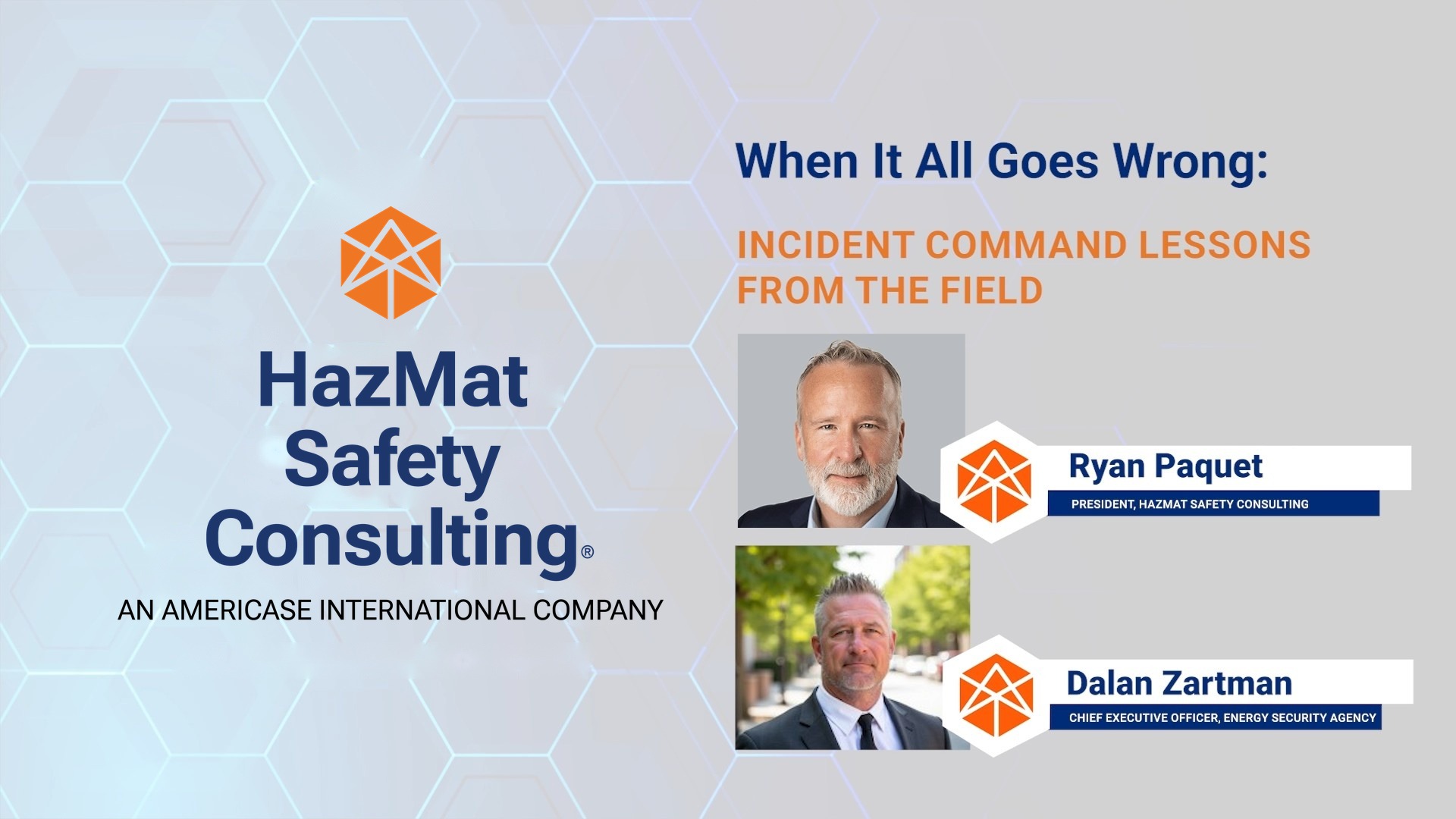
Former PHMSA official Ryan Paquet and veteran battery firefighter Dalan Zartman examine incident command communication failures in a free Nov. 10, 2026, LinkedIn Live session
Published Nov. 6, 2026 | Last updated Nov. 6, 2026
Key Facts
- HazMat Safety Consulting (HSC), an Americase International company, will host a free 60-minute LinkedIn Live webinar, “When It All Goes Wrong: Incident Command Lessons from the Field,” on Tuesday, Nov. 10, 2026, 11 a.m.–noon CST.
- Speakers are Ryan Paquet, president of HSC and former director of PHMSA’s Approvals and Permits Division, and Dalan Zartman, a career firefighter and CEO of Energy Security Agency.
- The session explains why critical failures in hazmat emergencies often happen before responders arrive, and how lithium-ion battery hazards make early decisions harder.
- Attendees receive a pre-incident readiness checklist. All registrants receive a recording.
At a Glance
| Event | When It All Goes Wrong: Incident Command Lessons from the Field |
| Format | Free webinar, 60 minutes, online via LinkedIn Live |
| Date and time | Tuesday, Nov. 10, 2026, 11 a.m.–noon CST (noon–1 p.m. EST) |
| Host | HazMat Safety Consulting, an Americase International company |
| Speakers | Ryan Paquet (HazMat Safety Consulting); Dalan Zartman (Energy Security Agency) |
| Audience | Emergency response directors, safety officers, logistics managers, corporate crisis teams, battery storage operators |
| Cost | Free; registration required |
| Takeaways | Pre-incident readiness checklist; recording for all registrants |
| Register | americaseinternational.com/when-it-all-goes-wrong-incident-command-lessons-from-the-field |
| Watch live | LinkedIn Live event page |
News Release
WAXAHACHIE, Texas – Nov. 6, 2026 – When a hazardous materials emergency goes wrong, the critical failures often happen before responders arrive, according to Ryan Paquet, a former director of the Pipeline and Hazardous Materials Safety Administration’s (PHMSA) Approvals and Permits Division.
“After an incident, everyone asks what the responders did. The better question is what the people upstream did to make sure command had the right information before anyone showed up,” said Paquet, now president of HazMat Safety Consulting, an Americase International company.
Paquet and Dalan Zartman, a career firefighter and CEO of Energy Security Agency, a battery-safety testing, emergency response and training firm, will examine those failures in “When It All Goes Wrong: Incident Command Lessons from the Field,” a free LinkedIn Live session on Tuesday, Nov. 10, 2026, from 11 a.m. to noon CST.
Why lithium-ion batteries make early decisions harder
Lithium-ion batteries have made those early decisions harder. After a big rig carrying large lithium-ion batteries overturned near the Port of Los Angeles in September 2024 and an explosion blew open its cargo container, Los Angeles Fire Department responders chose not to use water to avoid washing hazardous materials into Los Angeles waterways, and the batteries burned for days. In September 2026, a battery storage fire in La Verne, California, prompted evacuation orders for more than 500 homes.
“Lithium-ion batteries can always reignite hours or days after a fire appears to be out due to stranded energy still in the batteries,” Zartman said. “If the incident commander doesn’t know what hazards they are dealing with and how to address them, then everything is a potentially life altering gamble.”
What Attendees Will Learn
- What happens in the first 10 minutes of a hazmat emergency and where things can go wrong
- Why critical information doesn’t always reach incident commanders
- How responders make resource deployment decisions with limited information
- The challenges of coordinating public and private responders under the Incident Command System (ICS)
- How lithium-ion battery hazards shape suppression, evacuation and runoff decisions
Speakers
Ryan Paquet is president of HazMat Safety Consulting, an Americase International company. He is a former director of the Approvals and Permits Division at the U.S. Pipeline and Hazardous Materials Safety Administration (PHMSA).
Dalan Zartman is a career firefighter and CEO of Energy Security Agency, a battery-safety testing, emergency response and training firm.
Frequently Asked Questions
What is the “When It All Goes Wrong” webinar?
“When It All Goes Wrong: Incident Command Lessons from the Field” is a free 60-minute LinkedIn Live webinar hosted by HazMat Safety Consulting and featuring Energy Security Agency CEO Dalan Zartman. It examines how communication gaps and decisions in the first minutes of a hazmat emergency affect the outcome, with a focus on lithium-ion battery incidents.
When is the webinar?
Tuesday, Nov. 10, 2026, from 11 a.m. to noon Central Standard Time (noon to 1 p.m. Eastern).
Who are the speakers?
Ryan Paquet, president of HazMat Safety Consulting and former director of PHMSA’s Approvals and Permits Division, and Dalan Zartman, a career firefighter and CEO of Energy Security Agency.
Who should attend?
Emergency response directors, safety officers, logistics managers, corporate crisis teams and battery storage operators.
Is the webinar relevant if I’m not a firefighter?
Yes. Paquet’s point is that the critical failures often happen before responders arrive. The session looks at what shippers, carriers, operators and other people “upstream” do to make sure incident command has the right information.
Why are lithium-ion battery fires hard to manage?
Lithium-ion batteries can reignite hours or days after a fire appears to be out because of stranded energy still in the batteries, according to Zartman. Responders may also have to weigh fire suppression against the risk of washing hazardous materials into waterways.
What is stranded energy in a lithium-ion battery?
Stranded energy is electrical energy that remains in battery cells after a fire or damage. It can cause damaged batteries to heat up and reignite after a fire looks finished.
What is the Incident Command System (ICS)?
The Incident Command System is the standardized U.S. framework for command, control and coordination of emergency response. It lets fire departments, public agencies and private companies work under one command structure during an incident.
What happened in the 2024 Port of Los Angeles battery truck fire?
In September 2024, a big rig carrying large lithium-ion batteries overturned in San Pedro near the Port of Los Angeles, and an explosion blew open its cargo container. Los Angeles Fire Department commanders chose not to use water to avoid washing hazardous materials into Los Angeles waterways, and the batteries burned for days (LAFD).
What happened in the 2026 La Verne battery storage fire?
In September 2026, a fire in a lithium battery storage unit in La Verne, California, prompted evacuation orders for more than 500 homes (FOX 11 Los Angeles).
Does the webinar cost anything?
No. The webinar is free, but registration is required.
Will a recording be available?
Yes. A recording will be provided to all registrants, and attendees will receive a pre-incident readiness checklist.
How do I register?
Register on Americase International’s webinar registration page.
Are the speakers available for media interviews?
Yes. Paquet and Zartman are available for interviews before and after the session, and journalists may attend the live session at no cost. Contact Marina Malamis or Becca Cooper at marinam@hazmatsafety.com or 303-917-9888.
About HazMat Safety Consulting
HazMat Safety Consulting, an Americase International company based in Waxahachie, Texas, provides dangerous goods regulatory, compliance and safety consulting across the product and logistics lifecycle. Its consultants include former regulatory leaders and technical experts with experience at the U.S. Pipeline and Hazardous Materials Safety Administration (PHMSA) and in international dangerous goods rulemaking, helping organizations navigate U.S. Department of Transportation (DOT), International Civil Aviation Organization (ICAO), International Air Transport Association (IATA), International Maritime Dangerous Goods (IMDG) Code and other dangerous goods requirements.
HazMat Safety Consulting serves organizations across aerospace, defense, energy, healthcare, technology and industrial markets. Services span regulatory strategy and gap analysis; classification, packaging, marking, labeling and documentation; training and certification; emergency response planning; and safety management system development. To learn more, visit hazmatsafety.com.
Media Contact
Marina Malamis or Becca Cooper
marinam@hazmatsafety.com
303-917-9888