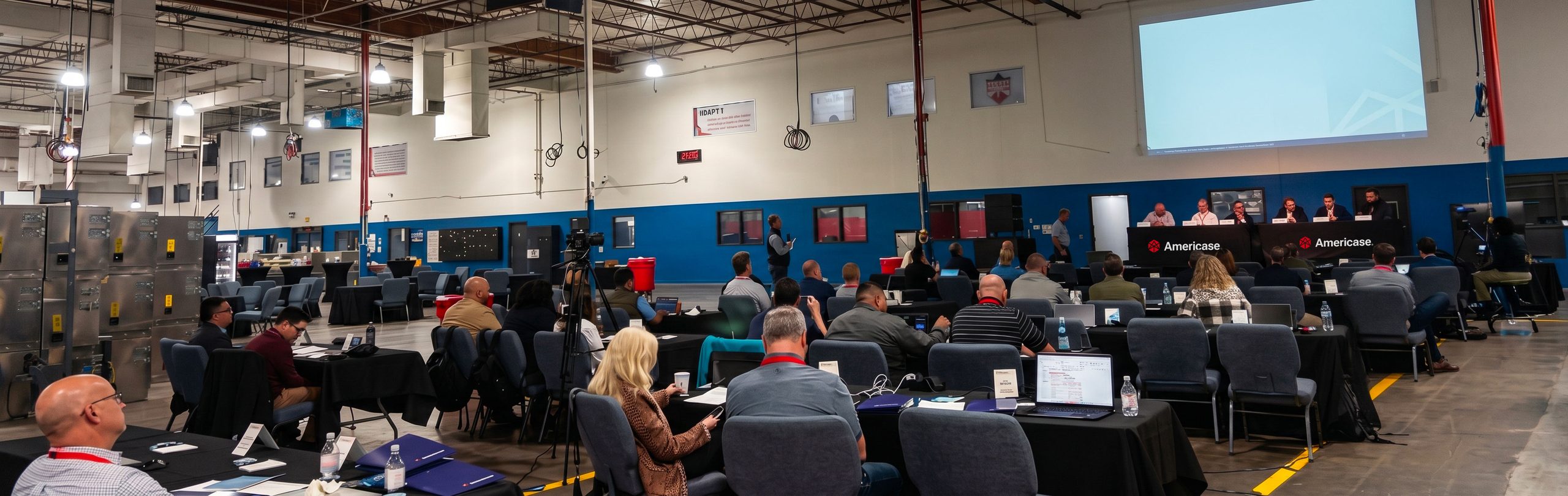
Safely Charging Ahead™ 2026, Oct. 22–23 near Dallas, brings together experts from the U.S. Department of Transportation, General Motors, Exponent and other organizations as global lithium-ion battery deployment grows sixfold in five years.
WAXAHACHIE, Texas — Sept. 29, 2026 — Americase International, a dangerous goods packaging, testing and compliance company, will pair expert keynotes and panels on battery regulation, transportation, storage, emergency response and recycling with nearly three hours of live battery failure testing at Safely Charging Ahead™ 2026: Battery Safety, Innovation, & Regulations Symposium™, a two-day program Oct. 22–23 at the Waxahachie Civic Center in Waxahachie, Texas, about 30 miles south of Dallas.
The live demonstrations will allow attendees to observe how different battery chemistries behave during failure, how thermal runaway can propagate and how containment configurations perform under test conditions. The program connects those observations with decisions about battery classification, transportation, storage, emergency preparedness and end-of-life management.
At a Glance
What: Safely Charging Ahead™ 2026: Battery Safety, Innovation, & Regulations Symposium™, hosted by Americase International
When: Oct. 22–23, 2026
Where: Waxahachie Civic Center, Waxahachie, Texas (about 30 miles south of Dallas)
Sessions: Keynotes and expert panels on battery regulation, hazard classification, transportation, emergency response, and recalls and recycling
Live demonstrations: Oct. 22, 1:30–4:15 p.m., Americase test facility (transportation provided)
Who should attend: Intermediate-to-expert battery safety, dangerous goods, compliance, operations, engineering, insurance and emergency response professionals
Speakers from: U.S. Department of Transportation, HazMat Safety Consulting, General Motors, Exponent, Pasha Hawaii, National Waste & Recycling Association, Energy Security Agency, Energy Safety Response Group, The Battery Network and Americase International
Cost: $575 per person
Register: americaseinternational.com/safely-charging-ahead (seating is limited; registration closes Oct. 19)
Media: For interview requests, contact Marina Malamis (see below)
Built around the five stages of The Battery Safety Lifecycle™ (Classify, Contain, Store, Respond and Retire), the program is designed for intermediate-to-expert battery safety, dangerous goods, compliance, operations, engineering, insurance and emergency response professionals. Speakers include Duane Pfund, former chairman of the UN Sub-Committee of Experts on the Transport of Dangerous Goods, and Ryan Paquet, former director of the Pipeline and Hazardous Materials Safety Administration (PHMSA) Approvals and Permits Division, both of HazMat Safety Consulting (HSC), alongside Americase International executives and experts from the U.S. Department of Transportation’s PHMSA, General Motors, Exponent, Pasha Hawaii, the National Waste & Recycling Association, the Energy Security Agency, Energy Safety Response Group and The Battery Network.
Investment in batteries for data centers, grid storage and mobility is moving faster than the codes that govern them, and the risk now extends across every mode of transport, storage and end of life. Global lithium-ion battery deployment in 2025 was six times as high as in 2020, according to the International Energy Agency (IEA), and insurer Allianz Commercial reports that lithium-ion batteries were linked to several large claims it handled in 2025, including a cargo fire at a North American warehouse. In the air, Federal Aviation Administration (FAA) data show 97 verified lithium battery-related events involving smoke, fire or extreme heat aboard aircraft in 2025, nearly two a week, up from 90 in 2024. Another 77 were verified in 2026 through Sept. 15. Of the 794 incidents the FAA has verified since 2006, 620 occurred on passenger aircraft and 147 on cargo aircraft. At end of life, waste and recycling facilities in the U.S. and Canada had a record 448 publicly reported fires in 2025, with lithium-ion batteries the leading cause, according to fire-detection company Fire Rover.
Regulations are also in flux. The UN Sub-Committee of Experts on the Transport of Dangerous Goods is weighing a hazard-based classification system that would classify lithium and sodium batteries by how they behave in testing rather than by chemistry, adding thermal runaway tests alongside UN 38.3, the UN test standard lithium batteries must pass before they can be shipped. If adopted at the Sub-Committee’s Nov. 23–Dec. 1, 2026, session, the changes would be considered for the 25th revised edition of the UN Model Regulations, with a transition period that could run to 2032. In the U.S., an early-stage PHMSA rulemaking, HM-224, would update requirements for transporting damaged, defective or recalled (DDR) lithium batteries and could further reshape compliance obligations across the battery lifecycle.
“Money is going into battery deployment faster than the rules can follow it, and the burden of that gap lands on the operator,” said Robby Kinsala, chief executive officer of Americase International. “If your compliance program is waiting for the regulation to show up, it’s already behind the asset you installed.”
Live Demonstrations
On Oct. 22 from 1:30 to 4:15 p.m., attendees will be transported to the Americase test facility for back-to-back battery failure testing. Planned demonstrations include:
- Hazard classification testing: The vent gas test the industry may soon need, run ahead of adoption. See how much gas a cell releases and whether it ignites.
- Single-cell thermal runaway: One cell of each chemistry, one after another: the same event, three very different reactions.
- Cell-to-cell propagation: How failure travels through a pack, and why a smaller cell isn’t automatically a smaller problem.
- Packaging comparison: A data center uninterruptible power supply/backup battery unit (UPS/BBU) at full scale, open air vs. contained. See why the regulations call for robust containment.
- Minimum vs. robust packaging: Footage of the same cells in basic and robust packaging: what minimum packaging holds, and what it doesn’t.
- Test evidence display: Drop-, stack- and oven-tested articles and past results, open for hands-on Q&A between live sessions.
Program Highlights
- Keynote — Regulation Is Behind the Investment (Oct. 22): Robby Kinsala
- Hazard-Based Classification and What It Changes (Oct. 22): Duane Pfund
- Keynote — Compliant Versus Contained (Oct. 22): Chris Egloff
- Expert Panels — transportation (Oct. 22); emergency response and quarantine (Oct. 23); recalls and recycling (Oct. 23); and emerging battery hazards (Oct. 23)
- Closing — The Custody Map™ (Oct. 23): a self-assessment designed to help attendees identify exposures across their own battery operations
“Passing a test isn’t the same as containing an event,” said Chris Egloff, chief revenue officer of Americase International. “We’ll show the difference on the test floor, in front of everyone.”
“Regulators are supposed to write rules based on what the data shows, and shippers should make their decisions the same way,” said Ryan Paquet, president of HazMat Safety Consulting and former director of PHMSA’s Approvals and Permits Division. “You don’t know how a battery is going to fail until you test it. What attendees see on Oct. 22 is the kind of evidence that should be driving packaging and compliance decisions.”
Featured speakers include:
Robby Kinsala, Chief Executive Officer, Americase International
Chris Egloff, Chief Revenue Officer, Americase International
John Redman, Chief Operating Officer, Americase International
Ryan Paquet, President, HazMat Safety Consulting; former director, Approvals and Permits Division, Pipeline and Hazardous Materials Safety Administration (PHMSA)
Duane Pfund, Senior Consultant, HazMat Safety Consulting; former chairman, UN Sub-Committee of Experts on the Transport of Dangerous Goods
Mike Pagel, Senior Consultant, HazMat Safety Consulting; formerly with the Hazardous Materials Information Center (HMIC) within the Pipeline and Hazardous Materials Safety Administration (PHMSA) at the U.S. Department of Transportation (DOT)
Tim Harris, Senior Global Manager of Dangerous Goods Transportation, General Motors
Hernan Sanchez, Ph.D., Principal Scientist, Exponent
Transportation expert, U.S. Department of Transportation (PHMSA)
Mike Gaffney, Technical and Energy Manager, Pasha Hawaii
Rachel Hering, CAE, Vice President of Chapter Relations, National Waste & Recycling Association
Dalan Zartman, Chief Executive Officer, Energy Security Agency
Nick Warner, Co-Founder and Principal, Energy Safety Response Group
Erik Frederickson, Vice President of Operations, The Battery Network
Registration is available at americaseinternational.com/safely-charging-ahead. Seating is limited; registration closes Oct. 19.
Frequently Asked Questions
What is Safely Charging Ahead 2026?
Safely Charging Ahead 2026: Battery Safety, Innovation, & Regulations Symposium is a two-day battery safety event hosted by Americase International on Oct. 22–23, 2026, in Waxahachie, Texas. It combines expert keynotes and panels on battery regulation, transportation, storage, emergency response and recycling with nearly three hours of live battery failure testing.
When and where is the symposium?
Sessions are held Oct. 22–23, 2026, at the Waxahachie Civic Center in Waxahachie, Texas, about 30 miles south of Dallas. Live battery failure demonstrations take place Oct. 22 from 1:30 to 4:15 p.m. at the Americase test facility, with transportation provided.
Who should attend?
The program is designed for intermediate-to-expert battery safety, dangerous goods, compliance, operations, engineering, insurance and emergency response professionals, including people responsible for classifying, packaging, shipping, storing, responding to incidents involving, or recycling lithium-ion and other batteries.
What live battery tests will be demonstrated?
Planned demonstrations include hazard classification (vent gas) testing, single-cell thermal runaway in three battery chemistries, cell-to-cell propagation, and a full-scale comparison of a data center uninterruptible power supply/backup battery unit (UPS/BBU) in open air vs. containment. Footage will compare minimum and robust packaging, and drop-, stack- and oven-tested articles will be on display for hands-on Q&A between live sessions.
What can attendees learn from live battery failure testing?
Attendees can observe how battery chemistry and configuration affect failure behavior, how thermal runaway can propagate, what gases may be released and how containment performs under specific test conditions. These observations can inform discussions about hazard classification, packaging, storage configuration and emergency response. Results from individual demonstrations should not be treated as universal performance claims for every battery or packaging design.
Who is speaking?
Speakers include Robby Kinsala, Chris Egloff and John Redman of Americase International; Ryan Paquet, Duane Pfund and Mike Pagel of HazMat Safety Consulting; a transportation expert from the U.S. Department of Transportation’s Pipeline and Hazardous Materials Safety Administration (PHMSA); Tim Harris of General Motors; Hernan Sanchez, Ph.D., of Exponent; Mike Gaffney of Pasha Hawaii; Rachel Hering, CAE, of the National Waste & Recycling Association; Dalan Zartman of the Energy Security Agency; Nick Warner of Energy Safety Response Group; and Erik Frederickson of The Battery Network. Pfund is a former chairman of the UN Sub-Committee of Experts on the Transport of Dangerous Goods, and Paquet is a former director of PHMSA’s Approvals and Permits Division.
What topics do the sessions cover?
Sessions follow The Battery Safety Lifecycle (Classify, Contain, Store, Respond and Retire). Topics include hazard-based classification, the gap between regulation and battery investment, compliant vs. contained packaging, transportation, emergency response and quarantine, recalls and recycling, and emerging battery hazards. The program closes Oct. 23 with The Custody Map, a self-assessment for identifying exposures across attendees’ own battery operations.
Why is battery safety regulation a concern now?
Battery use is growing faster than the rules that govern it. Global lithium-ion battery deployment in 2025 was six times as high as in 2020, according to the International Energy Agency. Incidents span the supply chain: the Federal Aviation Administration verified 97 lithium battery smoke, fire or extreme-heat incidents aboard aircraft in 2025 and 77 more in 2026 through Sept. 15, and waste and recycling facilities in the U.S. and Canada had a record 448 publicly reported fires in 2025, with lithium-ion batteries the leading cause, according to Fire Rover. International classification proposals and evolving transportation and facility-safety requirements add to the decisions facing manufacturers, operators and compliance professionals.
What regulatory changes will be discussed?
Sessions will examine a hazard-based classification system under consideration by the UN Sub-Committee of Experts on the Transport of Dangerous Goods, which would sort lithium-ion, sodium-ion and lithium metal batteries into five hazard categories (A through E) based on how they behave in testing rather than on their chemistry. The proposal adds thermal runaway tests measuring propagation, heat release and flammable gas generation, complementing UN 38.3, the UN test standard lithium batteries must pass before they can be shipped. If the Sub-Committee adopts it at its Nov. 23–Dec. 1, 2026, session, it would be considered for the 25th revised edition of the UN Model Regulations, with a transition period that could run to 2032. Duane Pfund, former chairman of the Sub-Committee, covers the proposal in his Oct. 22 session, Hazard-Based Classification and What It Changes. Speakers will also address PHMSA rulemaking HM-224, which would update U.S. requirements for transporting damaged, defective or recalled (DDR) lithium batteries, and the practical differences between transportation requirements and facility-storage obligations. Proposed requirements, adoption schedules and transition periods remain subject to the relevant regulatory processes.
How much does it cost, and how do I register?
Registration is $575 per person at americaseinternational.com/safely-charging-ahead. Seating is limited because attendance at the live demonstrations is capped by transportation capacity. Registration closes Oct. 19.
How can media arrange interviews?
Reporters can request interviews with Americase International and HazMat Safety Consulting experts by contacting Marina Malamis, Director of Marketing, Americase International, at marinam@americaseinternational.com or 303-917-9888.
###
About Americase International
Americase International, based in Waxahachie, Texas, brings together dangerous goods regulatory consulting, testing and validation, engineering, and protective packaging design and manufacturing capabilities. Through HazMat Safety Consulting, Americase and Fulcrum Testing, the company supports organizations managing high-value and dangerous goods across transportation, storage and other stages of the product lifecycle. It serves aerospace, defense, energy, medical, technology and other regulated industries. With more than 200 years of combined regulatory experience and more than 40 years in engineering, testing and manufacturing innovation, Americase International delivers proven, tested solutions. For more information, visit AmericaseInternational.com.
Media Contact
Marina Malamis, Director of Marketing
Americase International
marinam@americaseinternational.com
303-917-9888