
Article Summary
The U.S. and Canada have both updated their hazard communication rules to align with Revision 7 and certain provisions of Revision 8 of the UN GHS, but they took different paths and set misaligned transition periods. Under a 2013 MOU between U.S. OSHA and Canada’s Health Department, the Regulatory Cooperation Council (RCC) Workplace Chemicals Work Plan was created to keep the two countries’ GHS requirements aligned, and it worked well during the HCS 2012 rollout. This time, OSHA splits compliance between substances and mixtures with separate transition steps, while Canada offers a single three-year transition to the amended Hazardous Products Regulation (HPR) ending December 14, 2025. Both countries require that an SDS or label follow either the former or the amended rules during the transition and not a mix of the two. The gap is small for substances, since U.S. substance SDSs and labels must be updated by January 19, 2026, about a month after Canada’s deadline. For mixtures, however, the U.S. deadline falls roughly 18 months after Canada’s, so a single SDS or label for products exported to Canada would need to be updated far ahead of OSHA’s requirement or manufacturers must maintain two versions. The article outlines three industry options, including petitioning Health Canada to delay implementation to July 19, 2027, and notes that a one-year extension request has already been made.
The U.S. and Canada enjoy the world’s most comprehensive trading relationship, which supports millions of jobs in each country. We are each other’s largest trade partners with nearly $3.6 billion (U.S.$2.7 billion) worth of goods and services crossing the border every day in 2023. (Sept 2024)
In 2013 U.S. OSHA signed a Memorandum of Understanding (MOU) with Canada’s Health Department and the Regulatory Cooperation Council (RCC) Workplace Chemicals was born. The RCC developed a Workplace Chemicals Work Plan whose purpose was to ensure that current and future requirements for classifying and communicating the hazards of workplace chemicals will be acceptable in the U.S. and Canada without reducing worker safety.
One of the key elements of the Work Plan was to maintain alignment between the U.S. and Canadian requirements for implementing the GHS when revisions are made. This worked well during the implementation of the Hazard Communication Standard (HCS 2012).
Fast forward to today and we see that both U.S. and Canada have updated their existing regulations to align with Revision 7 and certain provisions of Revision 8 of the UN GHS.
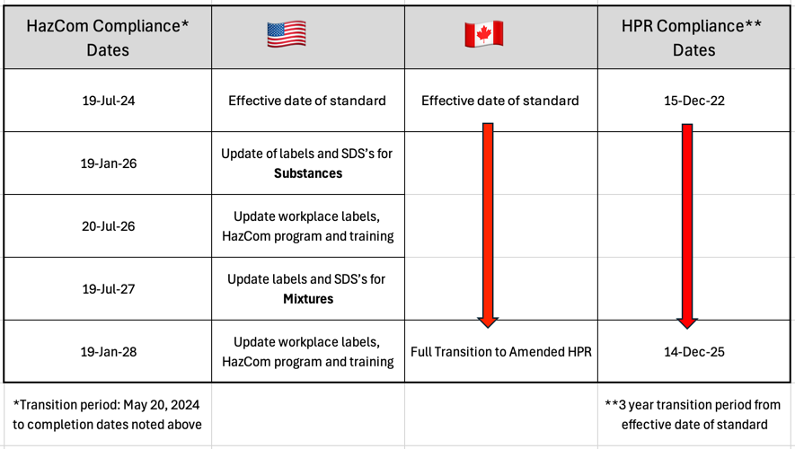
Unfortunately, U.S. and Canada have taken slightly different pathways to get to the same goal. OSHA is splitting compliance with the standard between substances and mixtures with transition periods tied to each step as seen below.
Canada provides no “baby step” effective dates, just a 3-year transition period to migrate from the former HPR (Hazardous Products Regulation) to the amended HPR by December 14, 2025.
Health Canada’s caveat is that during the transition period the SDS/Label will be either based on the former HPR or the amended HPR. This caution is echoed by OSHA.
In the immortal words of Dr. Egon Spengler (GhostBusters) who said, “Don’t cross the steams!” both the U.S. and Canada do not want to see an SDS/Label that has elements of both the former and updated regulations mashed together. You must choose to comply with one or the other during the respective transition periods.
This presents a very practical problem for the U.S. supply chain when exporting to Canada. If the goal is to have one SDS/Label compliant with both the U.S. and Canadian regulations, the U.S. SDS/Label could be based on Revision 3 of the UN GHS while Canada’s HPR will be using the amended HPR (Revision 7 with certain provisions of Revision 8).
The comparative timeline gap for substances is small as all substance SDS/labels in the U.S. must be updated by January 19, 2026 … approximately one month after the Canadian transition period ends.
However, mixtures being exported from U.S. to Canada have the potential to be impacted more significantly as the U.S. transition period ends approximately 18 months after the Canadian transition is complete.
What can industry do?
- Option 1: update all SDS’s and Labels for products exported to Canada by December 14, 2025 (impractical IMHO)
- Option 2: petition Health Canada* to delay implementation to July 19, 2027, matching OSHA’s deadline
- Option 3: ask OSHA’s representative on the RCC to bring this issue to the attention of Health Canada
*Note: Luc Séguin has already reached out to Health Canada asking for a one-year extension of the transition period to December 2026. Health Canada has indicated that they are “actively looking into” this issue.
Bottom Line
This represents an undue burden on industry as it will force U.S. manufacturers and distributors to either maintain 2 versions of the SDS/label for products exported from the U.S. to Canada or complete the update of their mixture SDS/label 18 months prior to the OSHA deadline.
FAQ
Q: Why are the U.S. and Canada’s GHS transition periods misaligned? A: Both countries updated their rules to align with Revision 7 and certain provisions of Revision 8 of the UN GHS, but took different pathways. OSHA splits compliance between substances and mixtures, with transition periods tied to each step, while Canada provides no interim effective dates, just a three-year transition to the amended HPR ending December 14, 2025.
Q: What is the Regulatory Cooperation Council (RCC) Workplace Chemicals Work Plan? A: It grew out of a 2013 MOU between U.S. OSHA and Canada’s Health Department. Its purpose is to ensure that requirements for classifying and communicating workplace chemical hazards are acceptable in both countries without reducing worker safety, including maintaining alignment when GHS revisions are implemented. The article notes this worked well during the implementation of HCS 2012.
Q: Can I mix elements of the old and new rules on an SDS or label during the transition? A: No. Both the U.S. and Canada caution against an SDS or label that combines elements of the former and updated regulations. During the transition period, you must choose to comply with one or the other.
Q: How large is the timing gap for substances versus mixtures? A: For substances, the gap is small: U.S. substance SDSs and labels must be updated by January 19, 2026, about a month after the Canadian transition period ends. For mixtures, the U.S. transition period ends roughly 18 months after Canada’s, so the impact on products exported to Canada is more significant.
Q: What problem does this create for U.S. exporters to Canada? A: If a company wants one SDS or label that complies with both countries’ rules, the U.S. version could be based on Revision 3 of the UN GHS while Canada’s amended HPR uses Revision 7 with certain provisions of Revision 8. The article calls this an undue burden, since U.S. manufacturers and distributors must either maintain two versions of the SDS or label for exports to Canada or finish updating mixtures 18 months before the OSHA deadline.
Q: What options does industry have to address the misaligned deadlines? A: The article lists three: update all SDSs and labels for products exported to Canada by December 14, 2025 (which the author calls impractical), petition Health Canada to delay implementation to July 19, 2027 to match OSHA’s deadline, or ask OSHA’s representative on the RCC to raise the issue with Health Canada. Luc Séguin had already asked Health Canada for a one-year extension to December 2026, and Health Canada indicated it was actively looking into the issue.